paper preview
01arXiv
DAWN: Noise-Robust Quadruped Parkour via Depth-Denoising World Models
Noise-robust vision-based quadruped parkour using depth-denoising world models.

Terrain, gait, robustness, and agile movement.
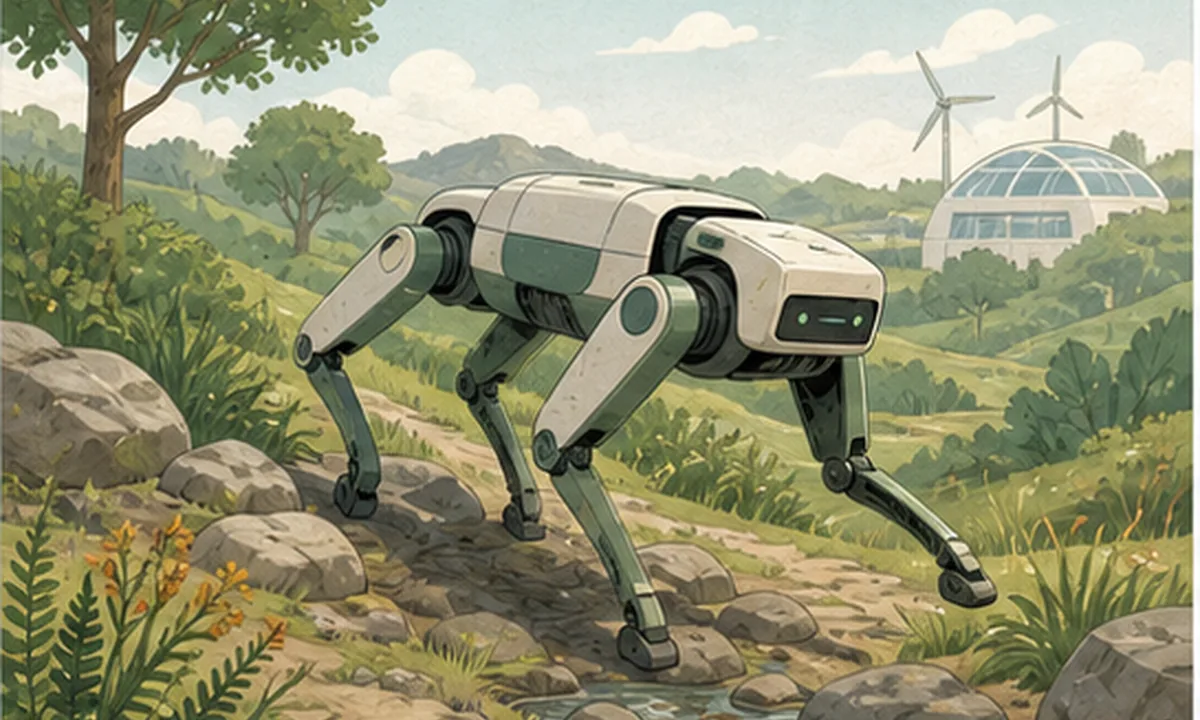
Noise-robust vision-based quadruped parkour using depth-denoising world models.
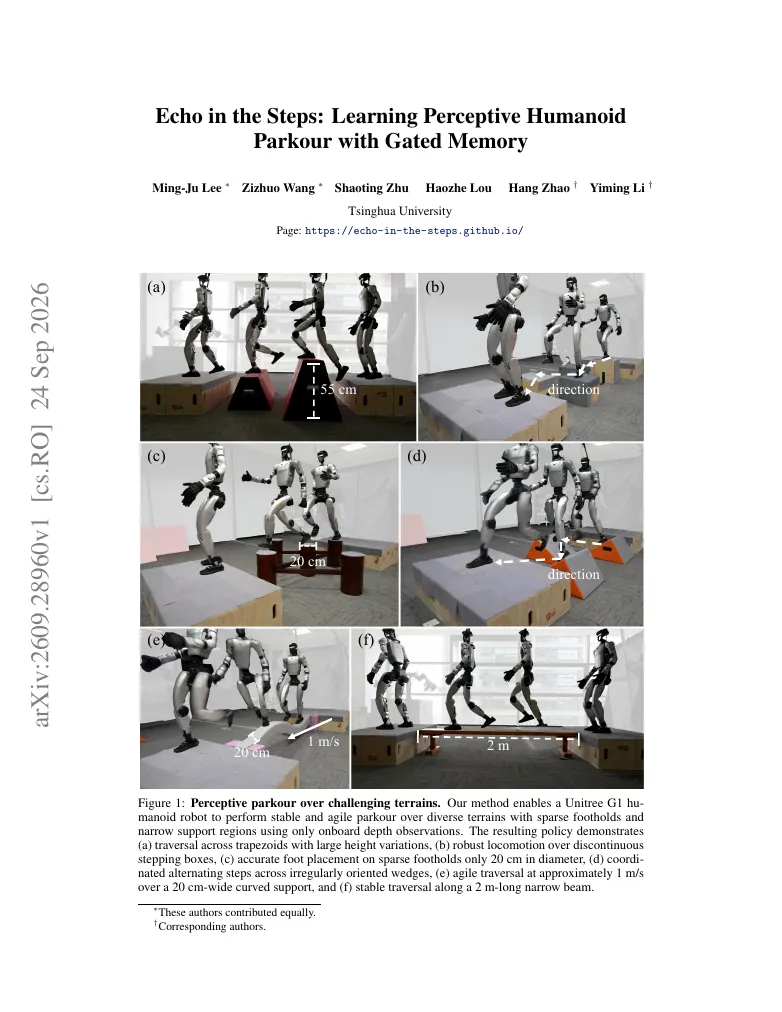
Perceptive humanoid parkour with saliency-guided gated memory for foothold selection.
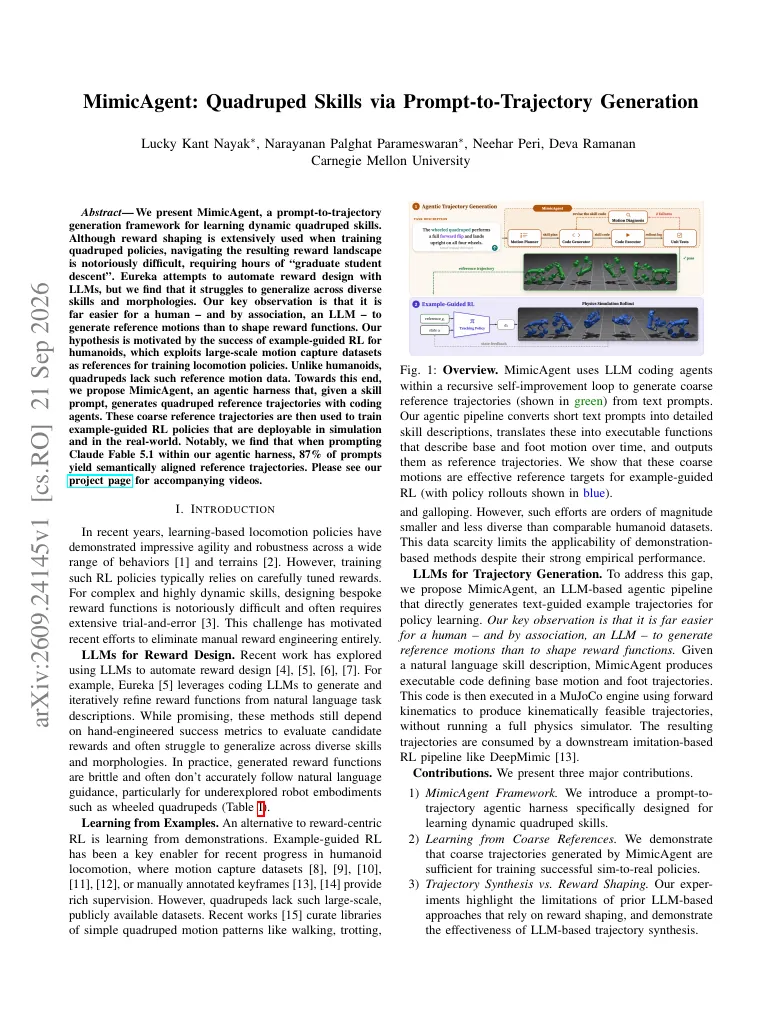
Agentic framework for prompt-to-trajectory generation for quadruped RL training.
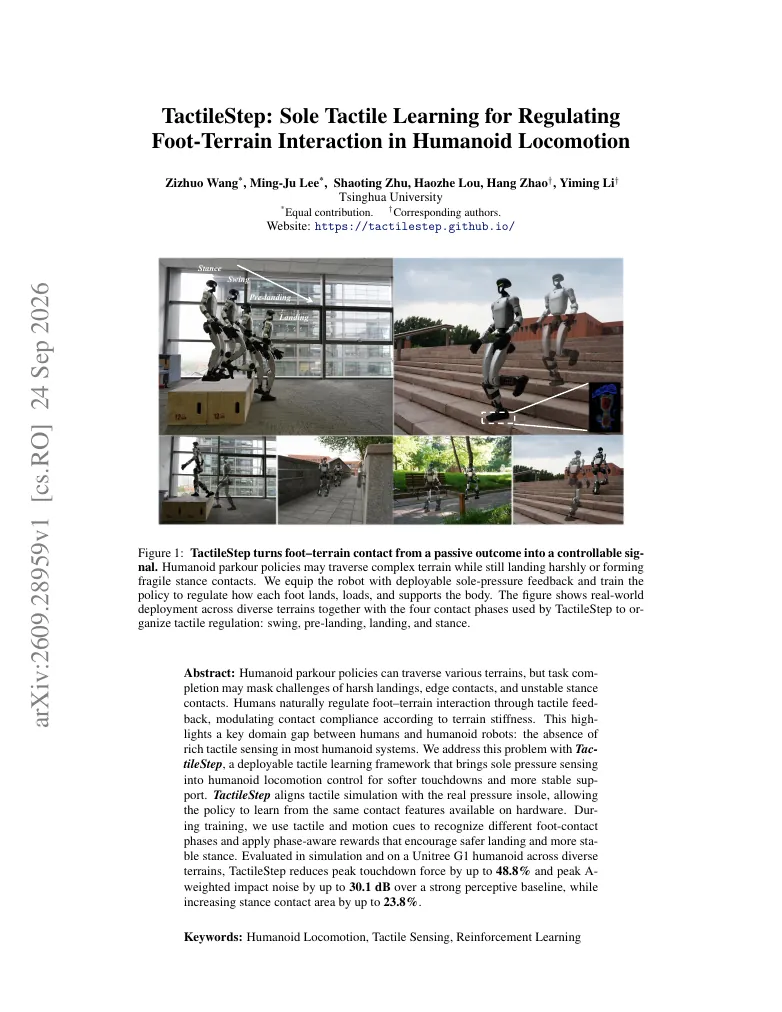
Tactile learning framework using sole pressure sensing for safer humanoid foot-terrain interaction, phase-aware rewards, and sim-to-real alignment on Unitree G1.
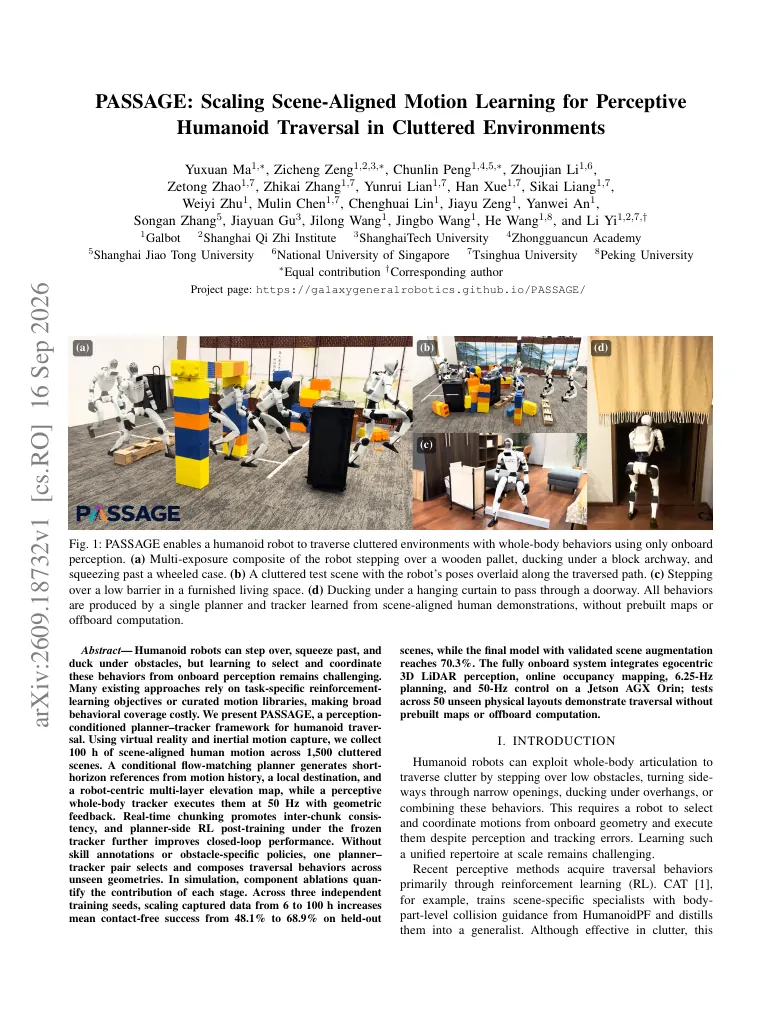
Perception-conditioned planner-tracker for humanoid traversal in cluttered scenes using human motion data and flow-matching.
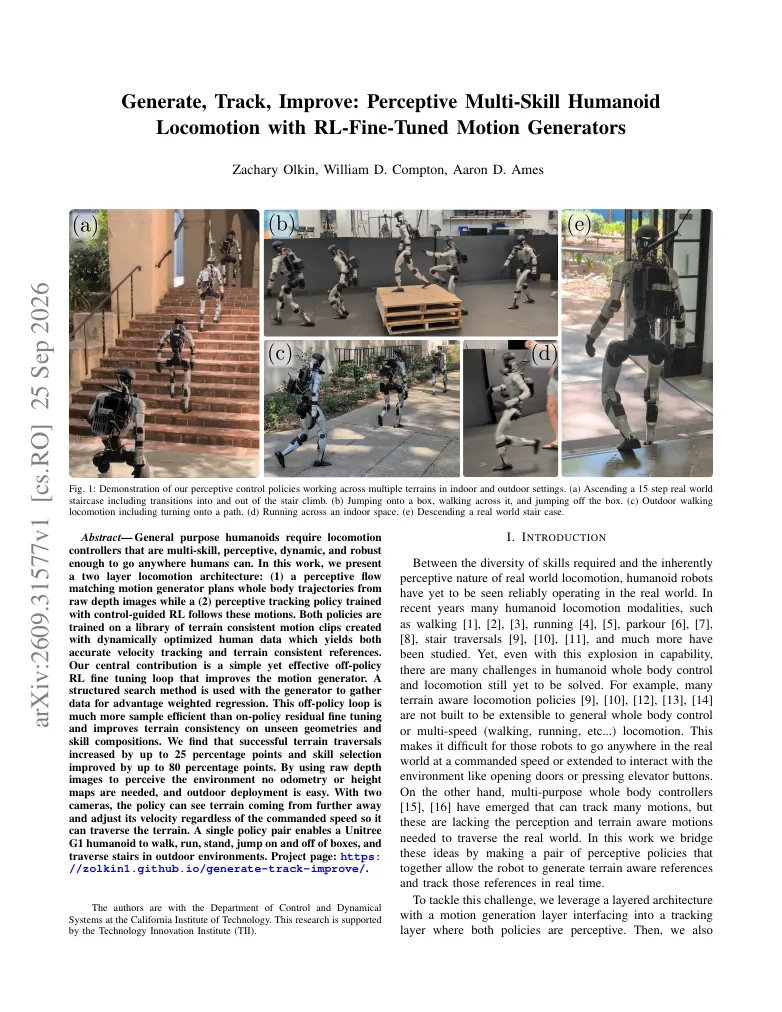
Two-layer perceptive humanoid locomotion: flow-matching motion generator from raw depth images plans whole-body trajectories; RL tracking policy follows them. RL fine-tunes generator on ter...
A multi-jointed underwater robot uses the same structure for swimming and legged locomotion.
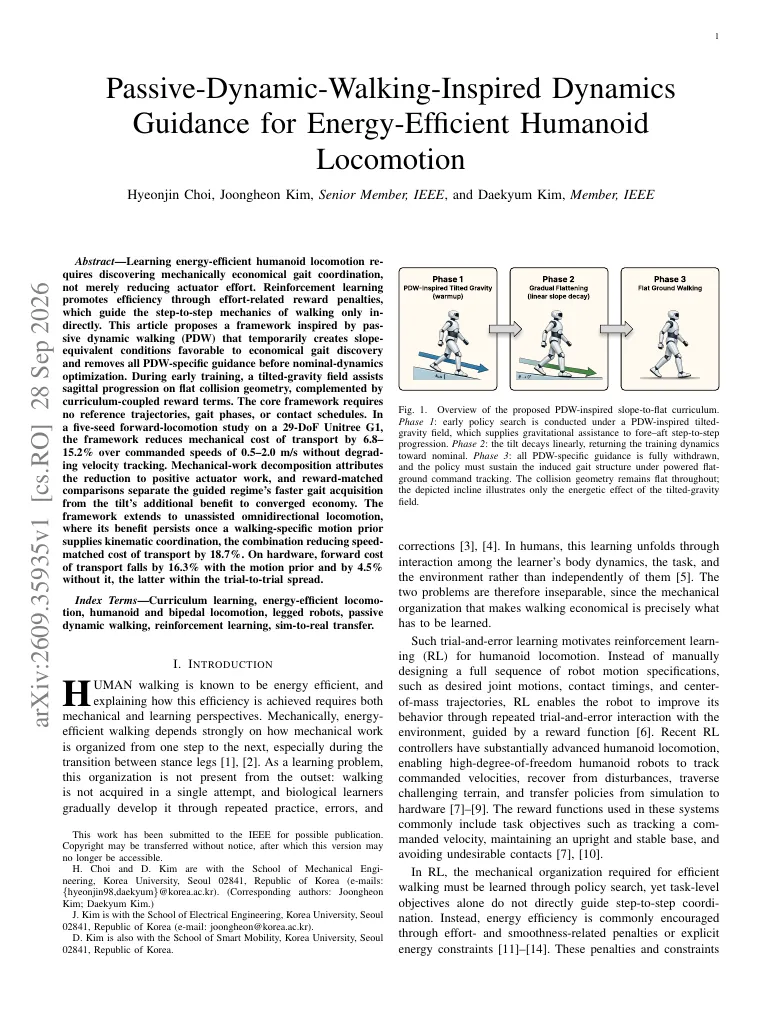
Guide economical humanoid gait discovery with temporary passive-dynamic-walking-inspired conditions.
Allocate training experience toward rare locomotion failures using predicted future safety cost.
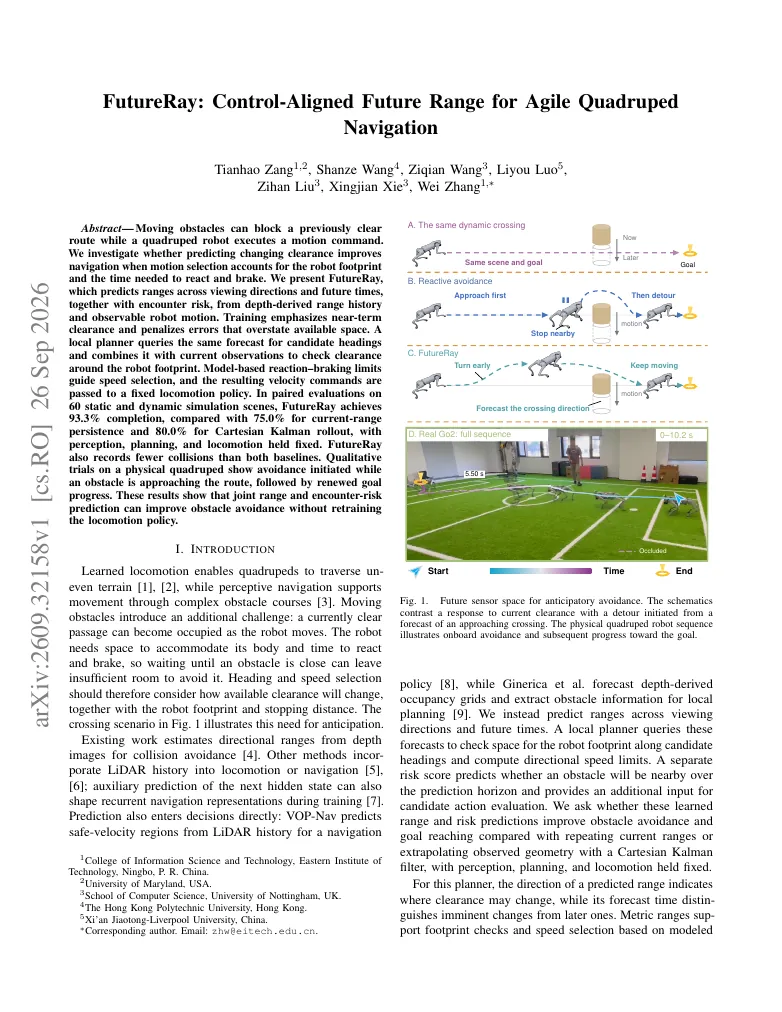
Forecast clearance and encounter risk with footprint/reaction-braking constraints for quadruped avoidance.
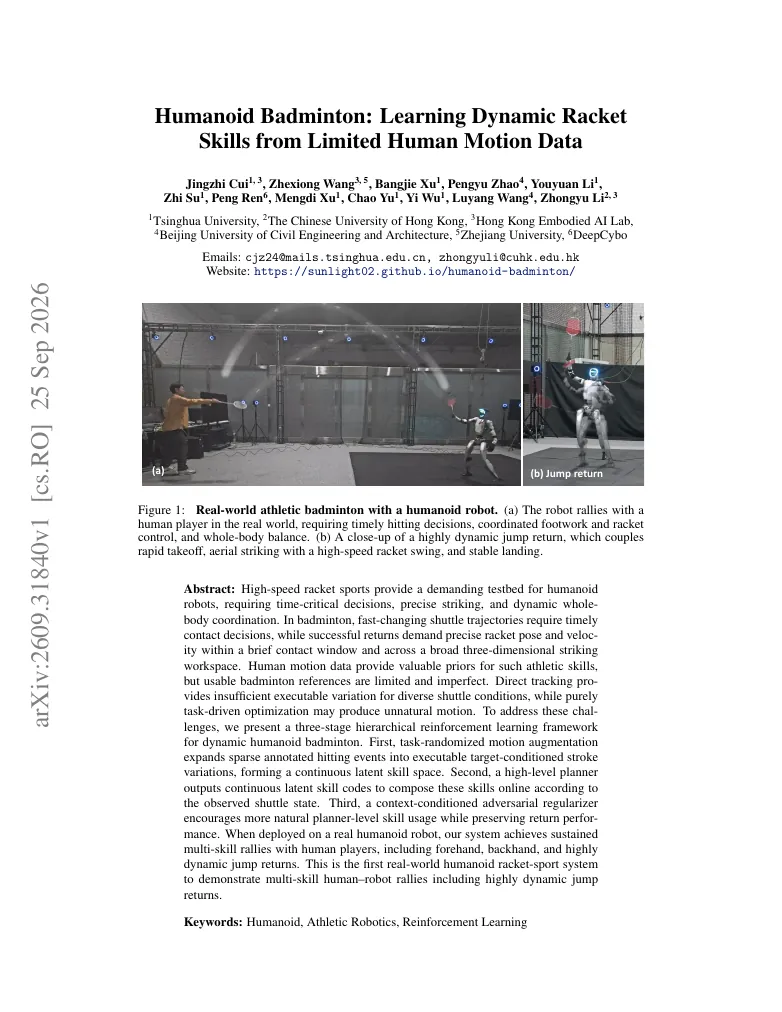
Hierarchical RL composes dynamic badminton skills from sparse imperfect human motion data.
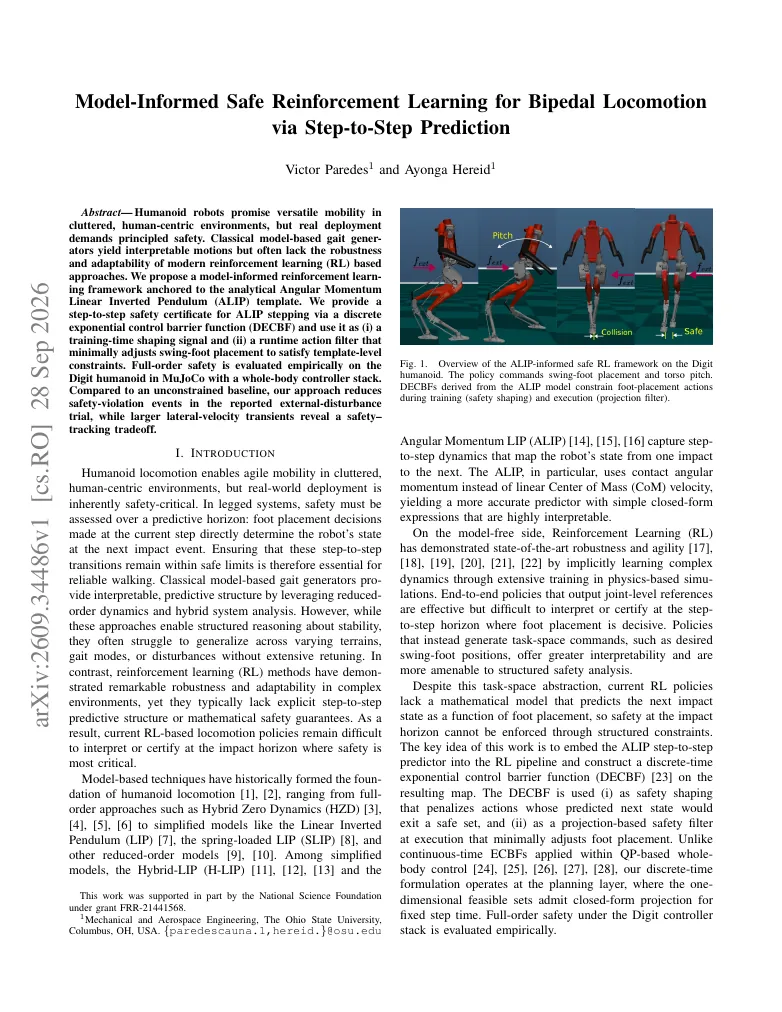
Combine analytical stepping safety certificates with learned bipedal locomotion.
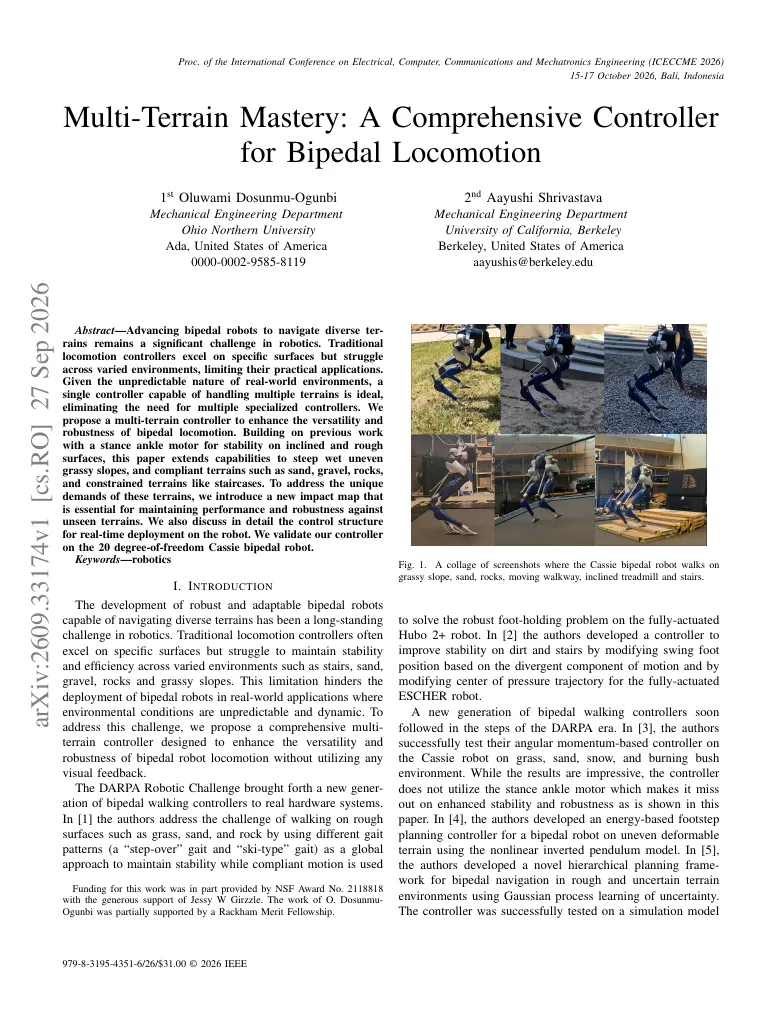
One bipedal controller handles varied slopes, compliant ground and constrained stairs.
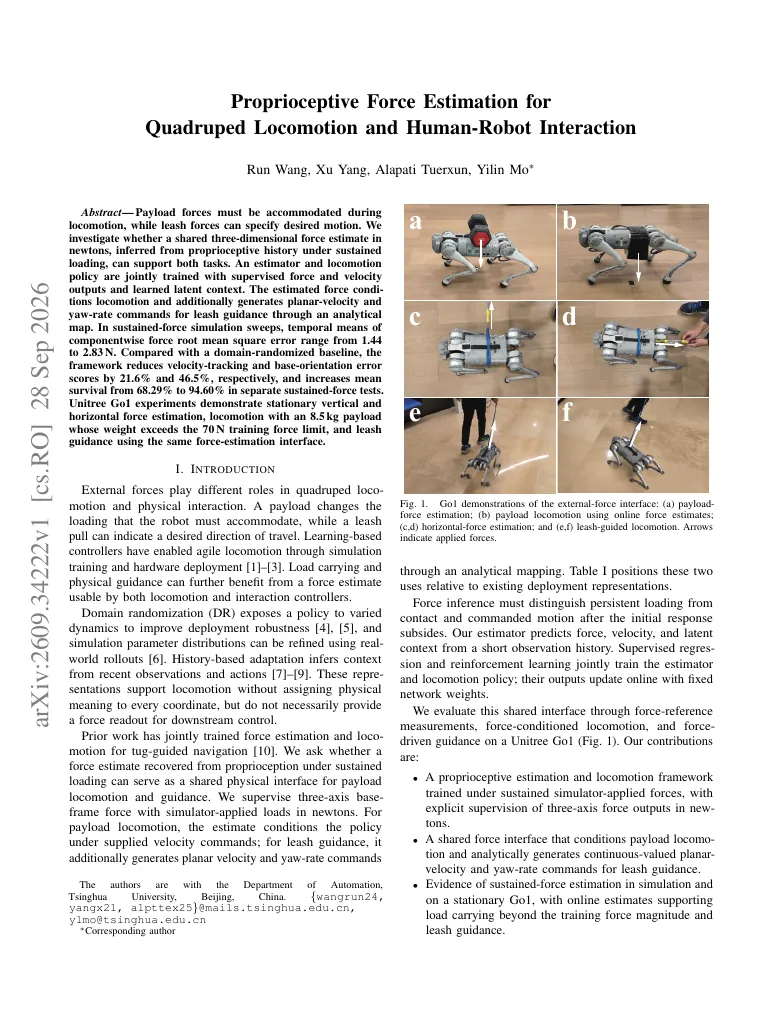
One proprioceptive force estimate supports payload accommodation and leash-guided locomotion.
Ground VLM judgments in a cost map that guides safe quadruped trajectory selection.
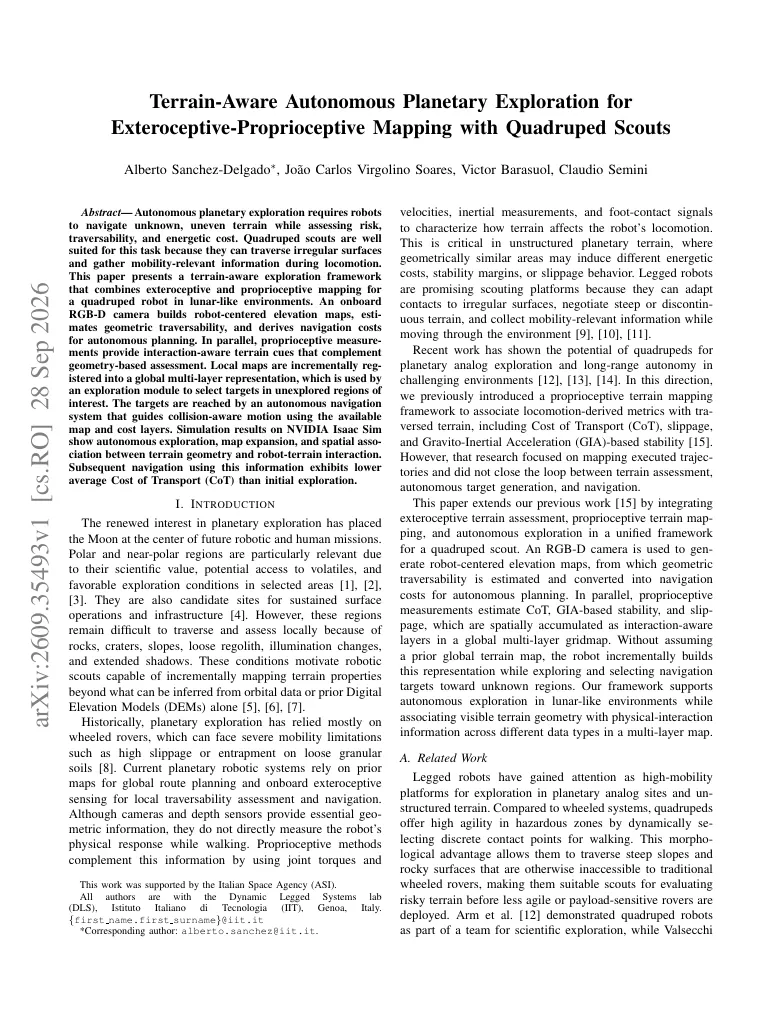
Fuse terrain geometry and robot-terrain interaction to improve quadruped exploration and energetic planning.
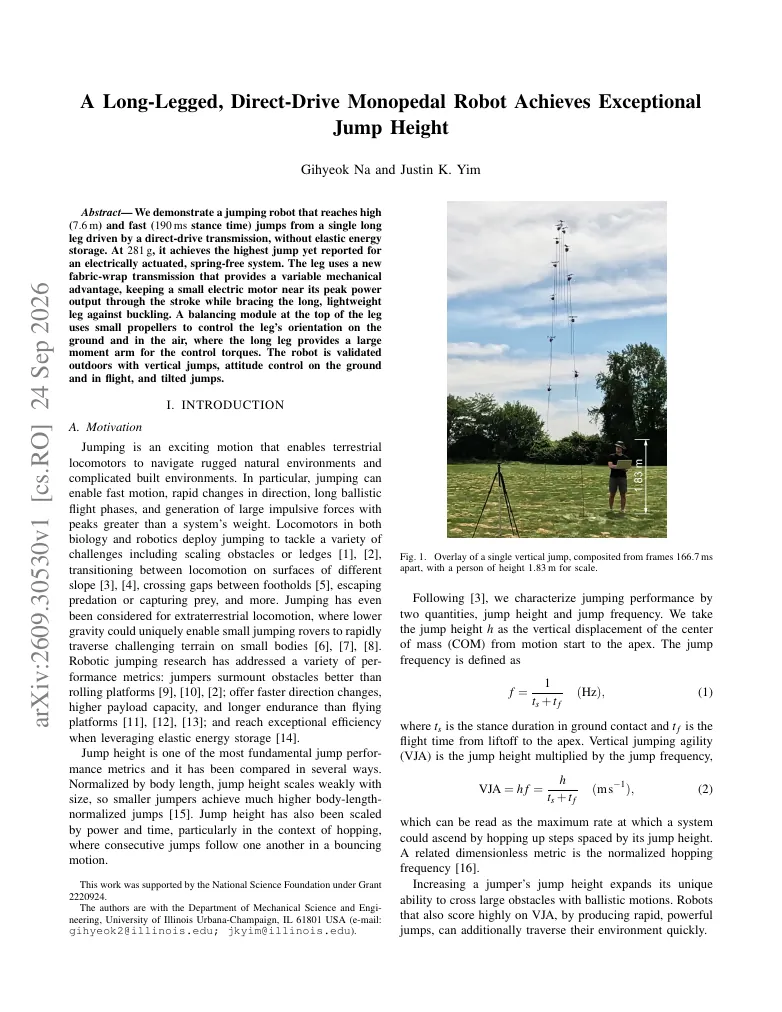
A lightweight direct-drive monoped jumps high without elastic energy storage.
Smooth stiff-contact gradients locally while retaining dynamics fidelity for deployable humanoid policies.
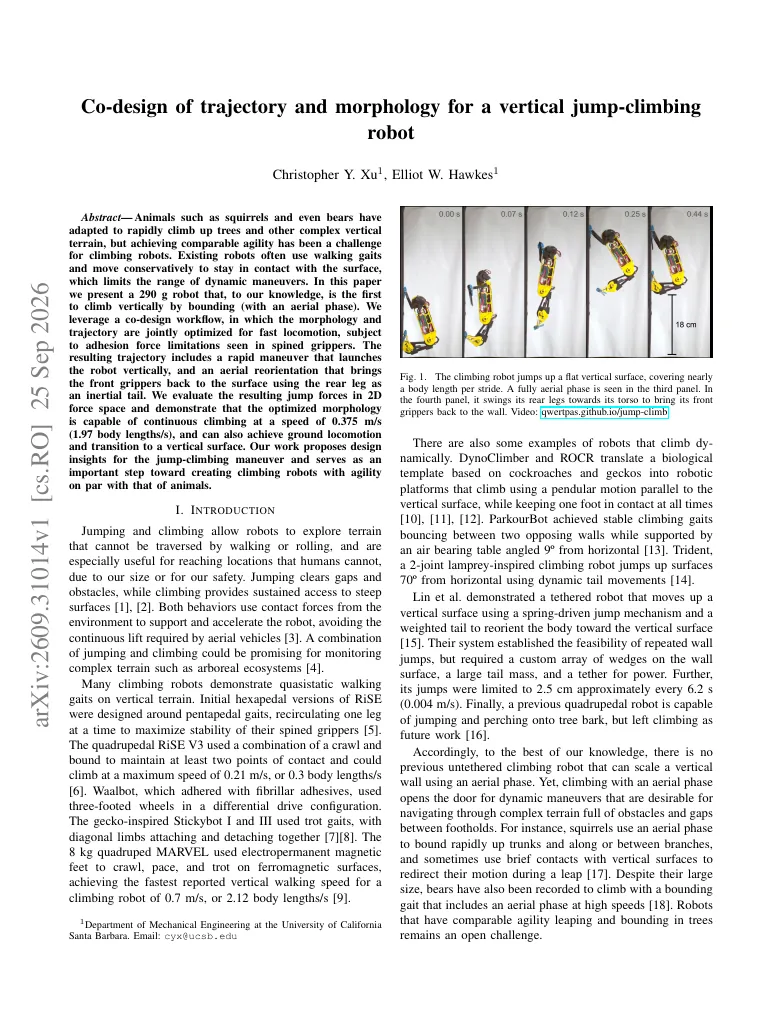
Co-design body geometry and motion for dynamic vertical bounding under adhesion limits.
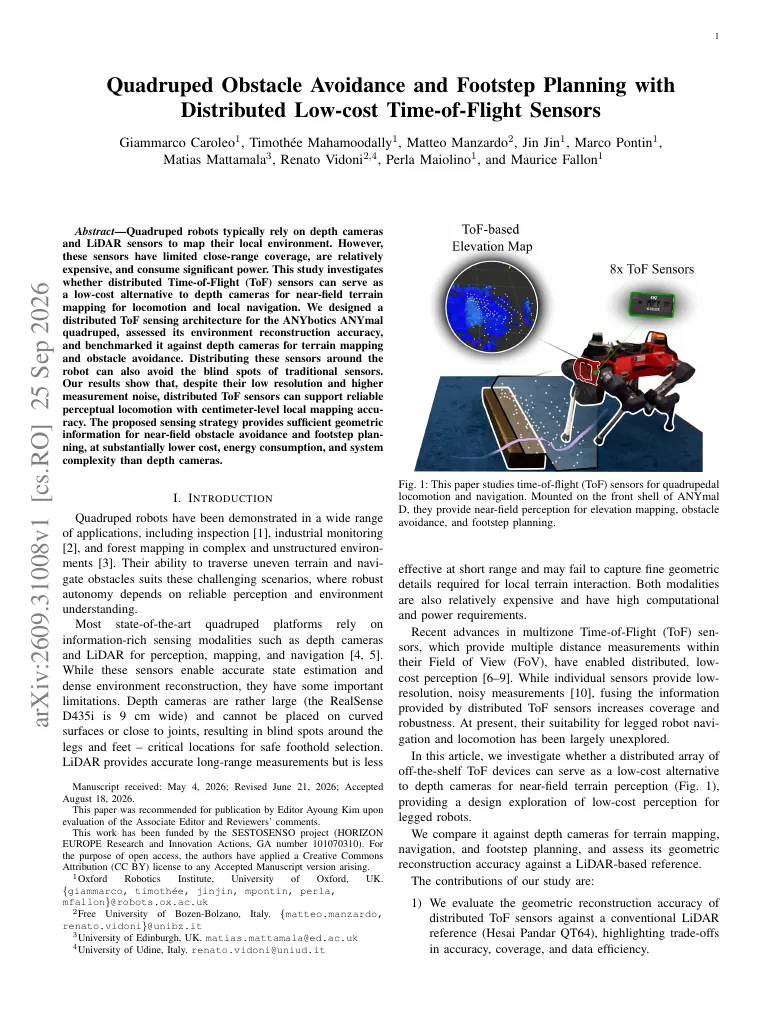
Distributed low-cost ToF sensing supplies near-field geometry for quadruped locomotion.
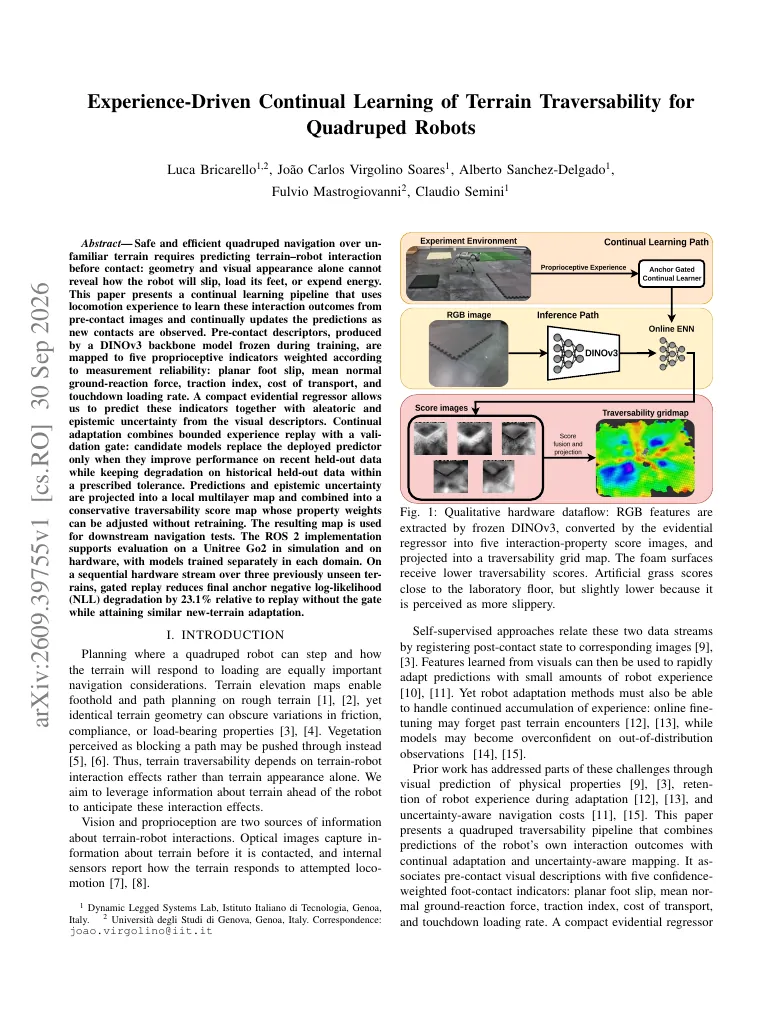
Validation-gated continual learning maps pre-contact vision to uncertainty-aware, experience-derived traversability for a Unitree Go2.
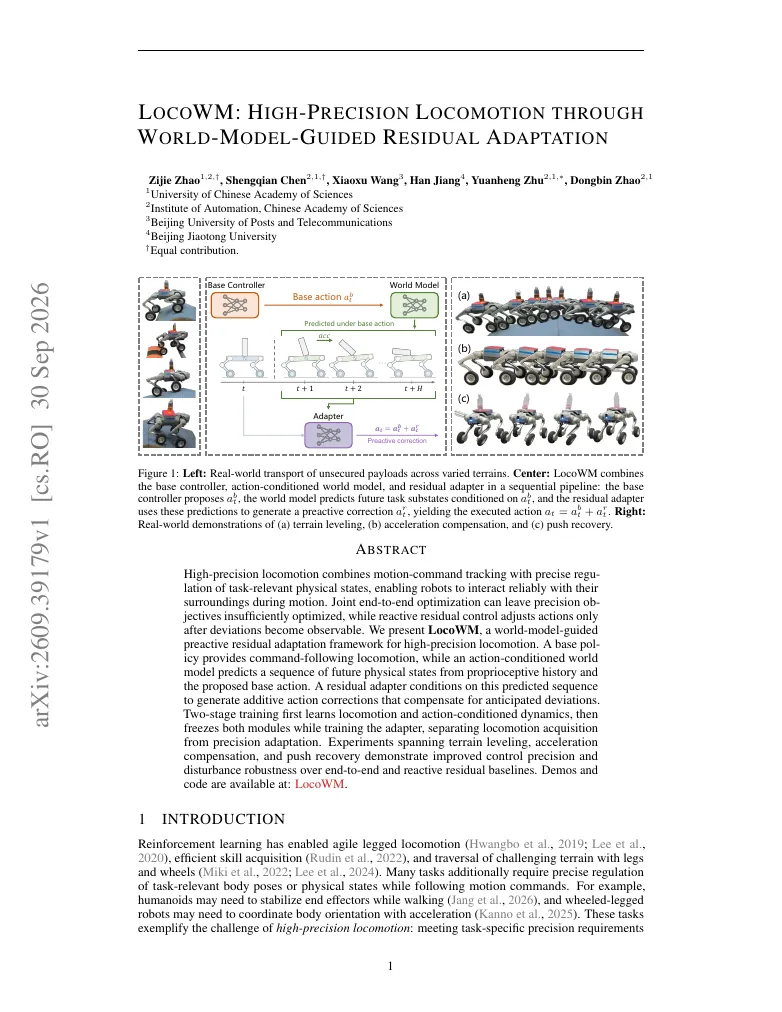
World-model-guided residual adaptation for high-precision legged locomotion with terrain leveling, acceleration compensation, and push recovery.
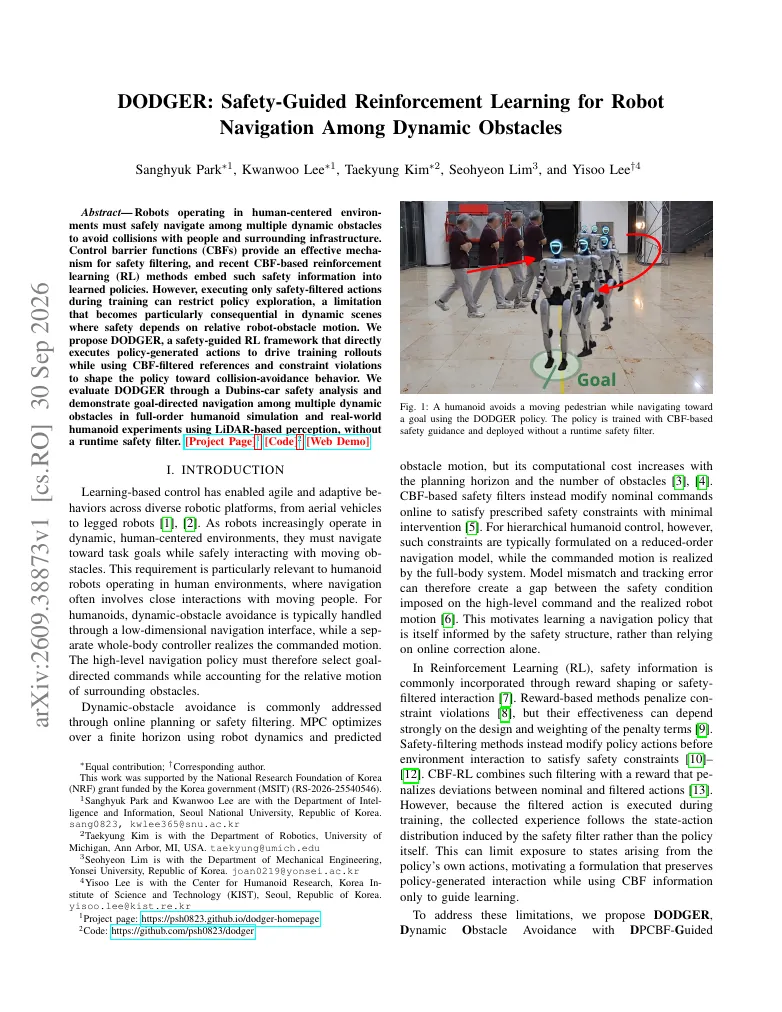
Safety-guided RL for humanoid navigation among dynamic obstacles using CBFs without runtime filtering.
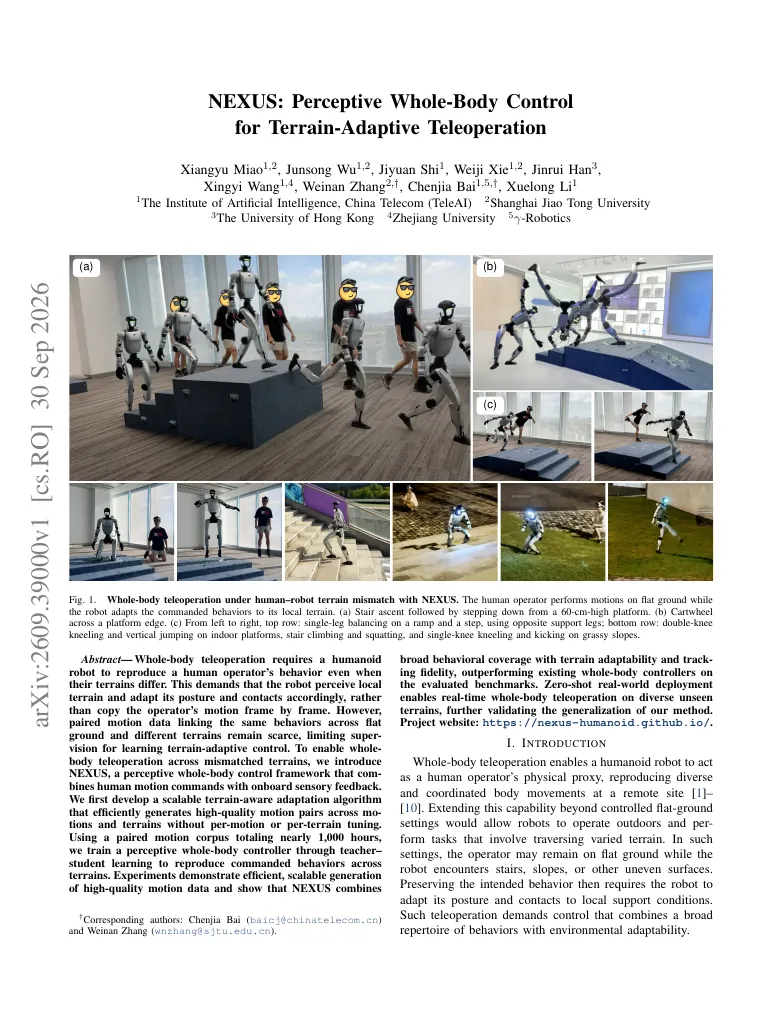
Perceptive whole-body controller for humanoid teleoperation across mismatched terrains using teacher-student learning on large paired motion corpus.
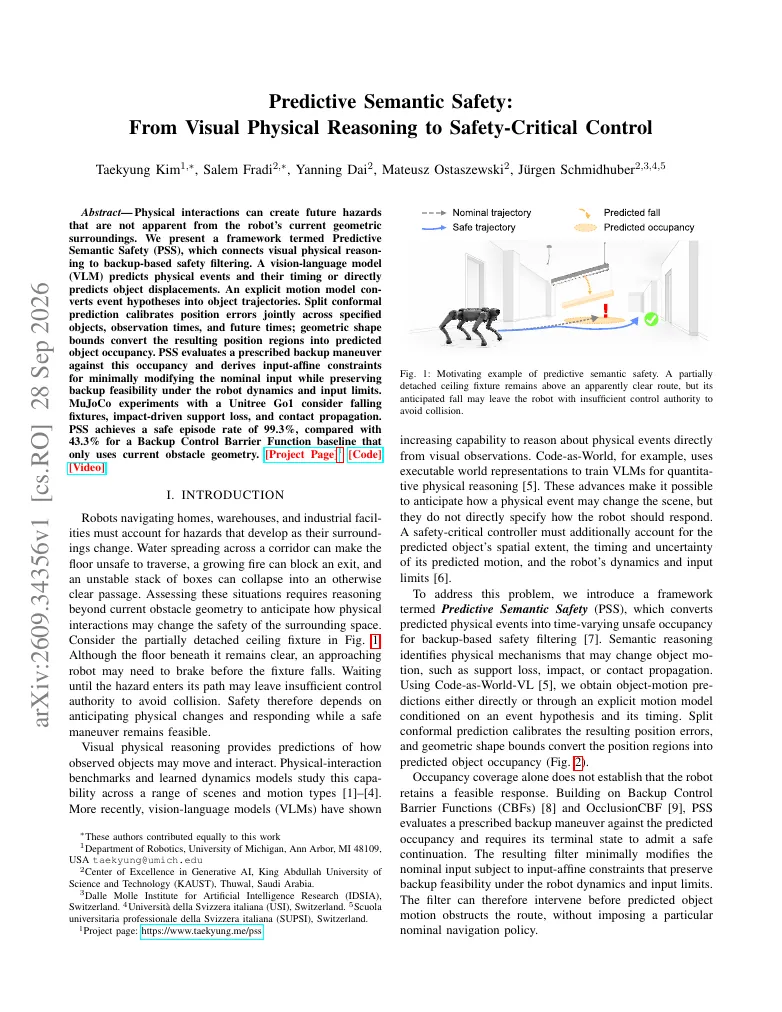
Predictive Semantic Safety framework using VLM for physical event prediction and conformal-calibrated safety filtering on quadruped.
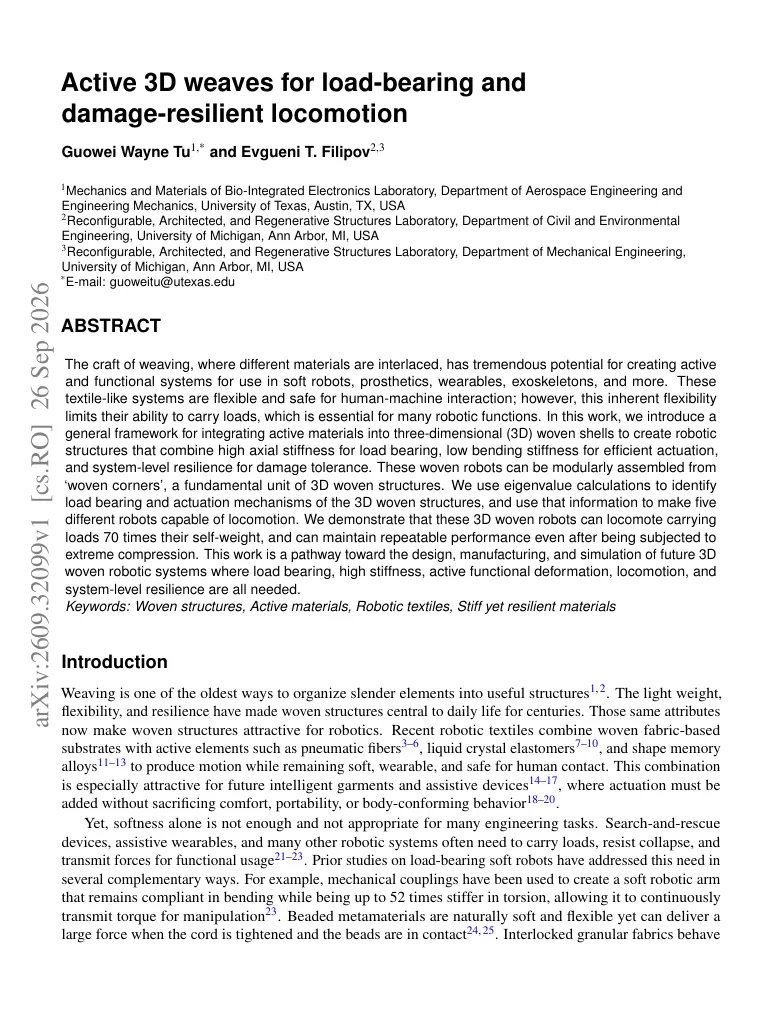
Shape-memory-alloy 3D woven walkers, crawlers, and four-legged robots combine limb-driven locomotion with extreme load bearing and post-compression recovery.
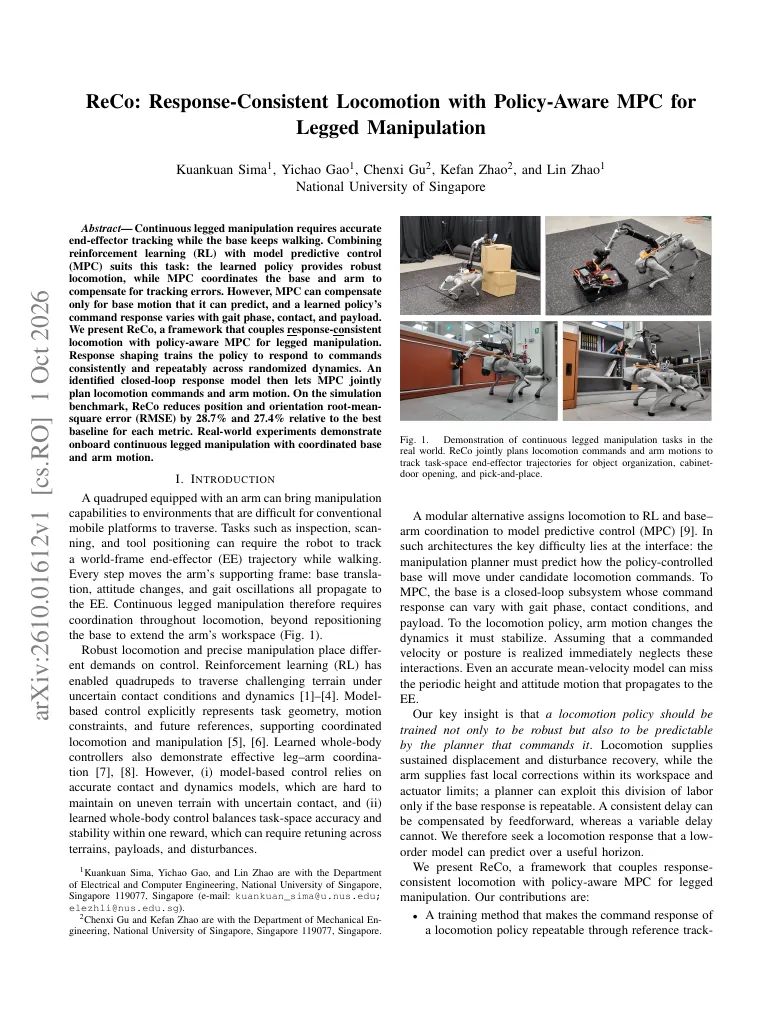
Response shaping of RL locomotion policy plus identified closed-loop model enables policy-aware MPC for continuous world-frame EE tracking on Go2+X5.
VAPS uses viability predictors and a hierarchy of nominal, abort, and protective-fall policies to reduce hardware damage during humanoid flips on G1 and Oli.
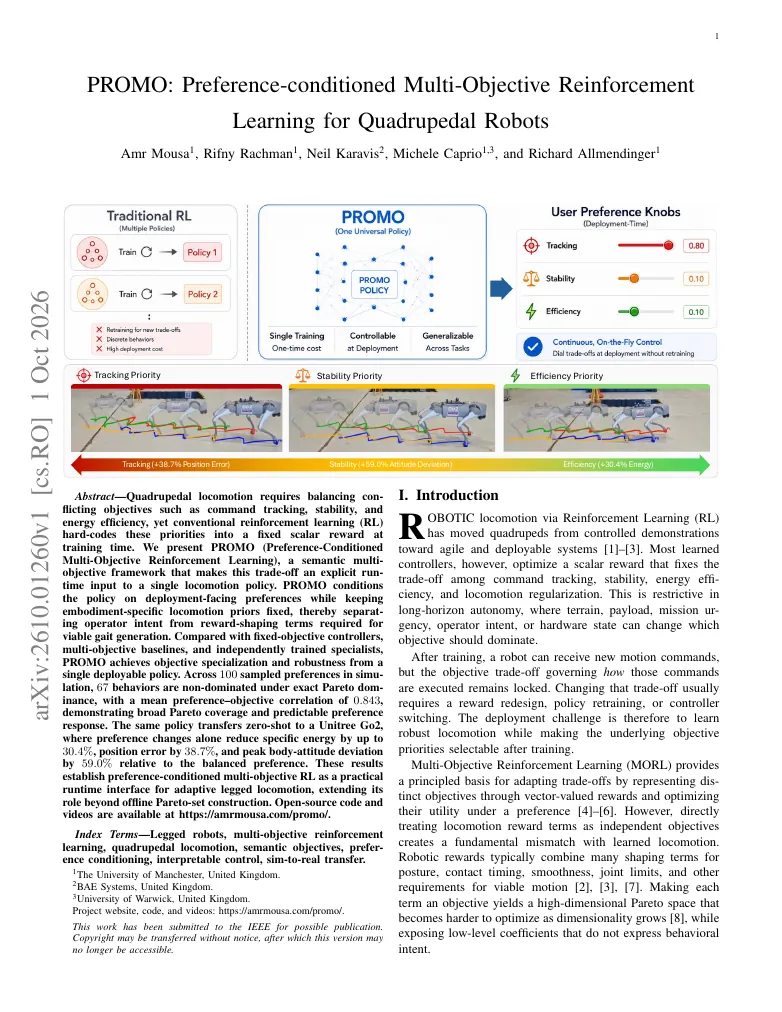
PROMO conditions a single quadruped policy on runtime semantic preferences over tracking, stability, and efficiency while keeping locomotion priors fixed.
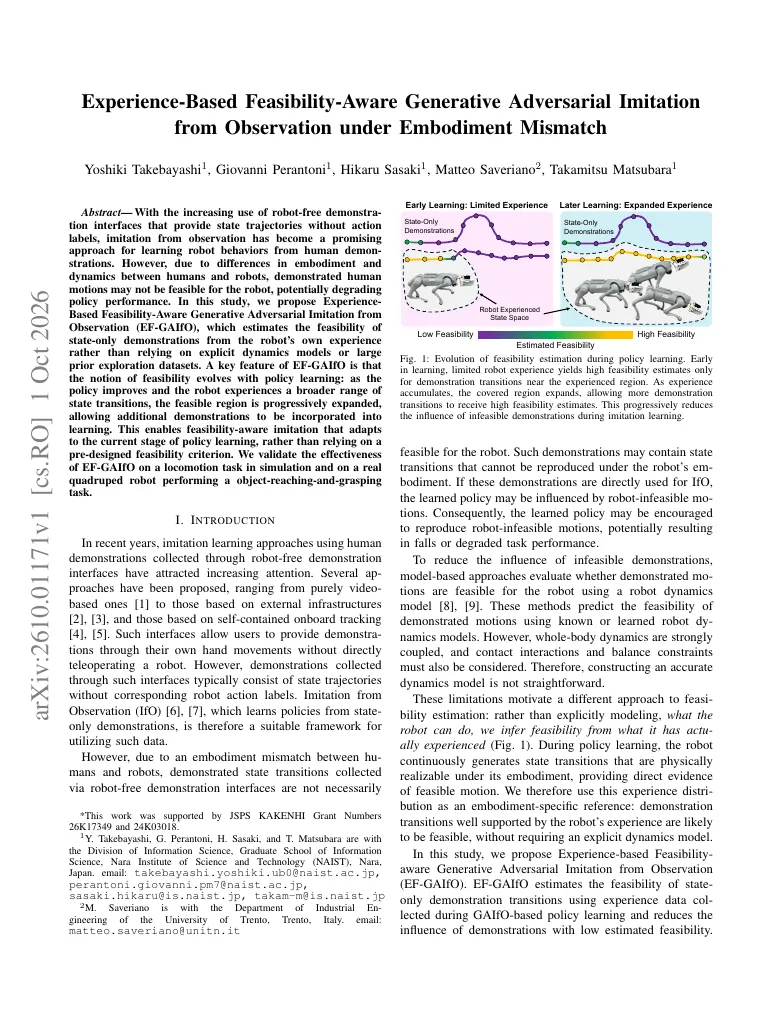
EF-GAIfO estimates feasibility of state-only demonstrations from robot experience for imitation under embodiment mismatch, validated on simulation locomotion and real Unitree Go2 object-rea...
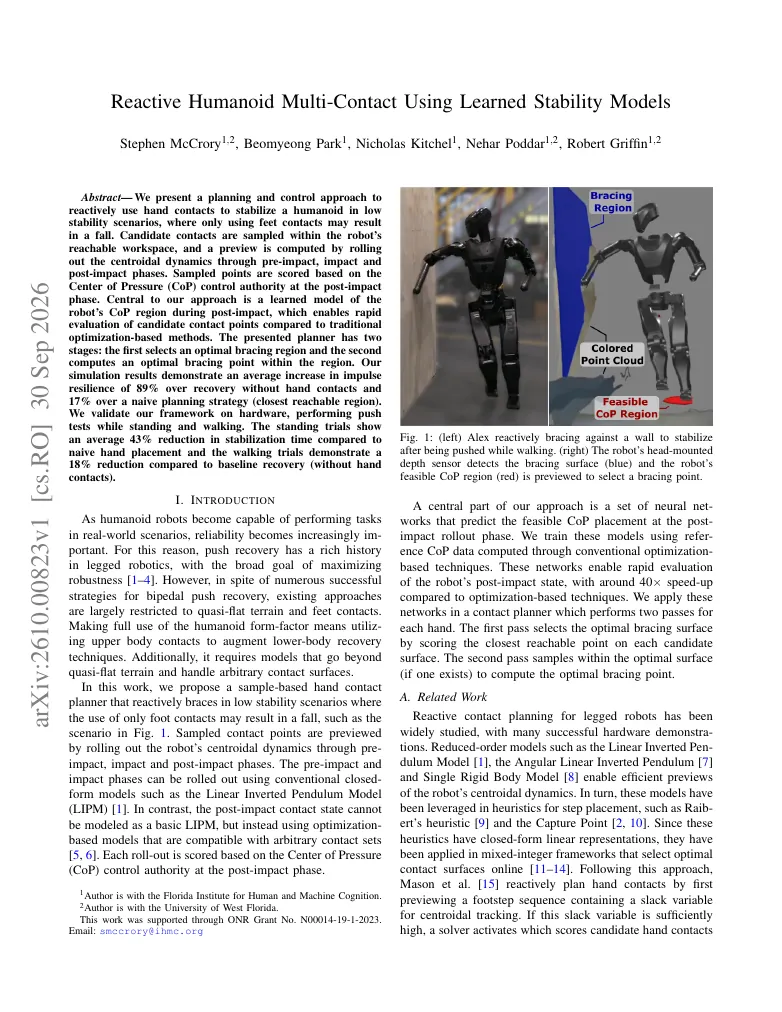
Reactive planner uses learned CoP region models to select hand bracing contacts that increase impulse resilience on the Alex humanoid, validated in simulation and hardware push recovery.
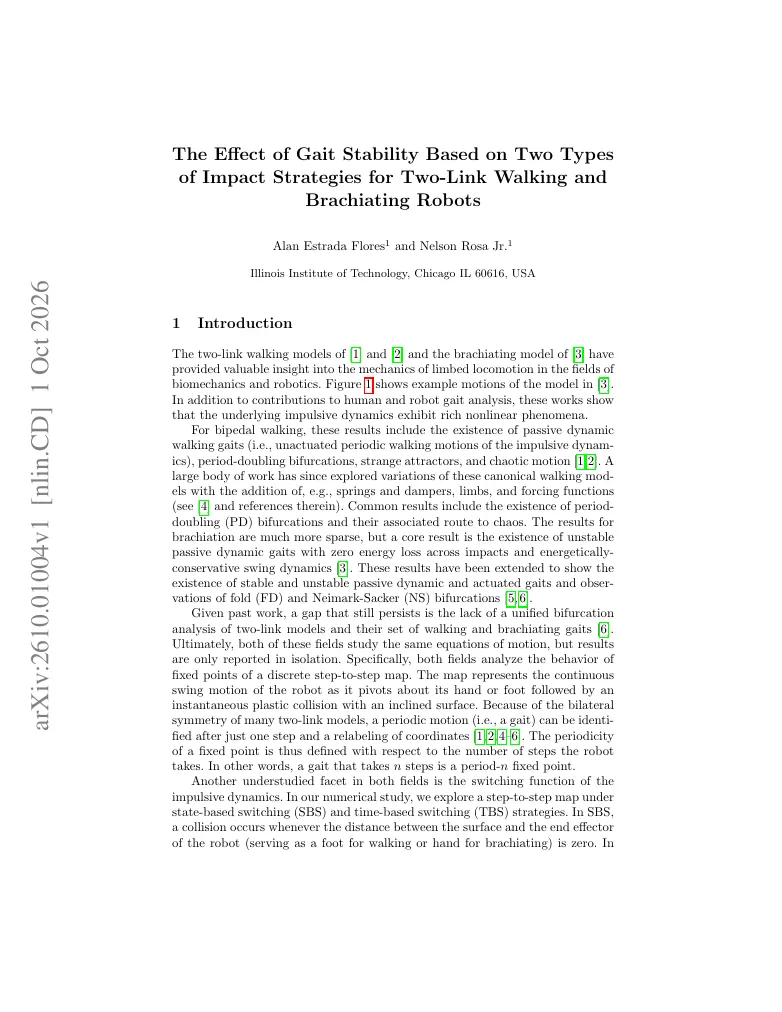
Numerical study of passive dynamic gait families in two-link walking and brachiating models under state-based and time-based impact switching.
Reference motion, imitation, retargeting, and behavior priors.
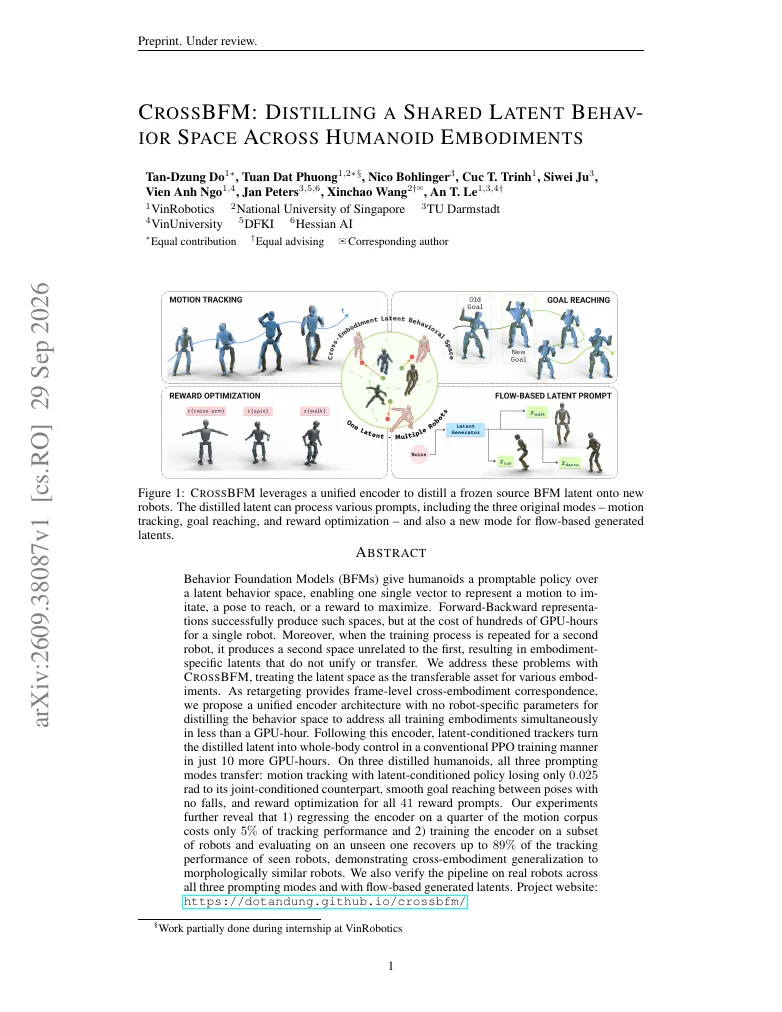
Shared G1 behavior latents transfer through a unified encoder to per-robot PPO humanoid trackers; supports motion, goals, rewards and flow-generated commands.
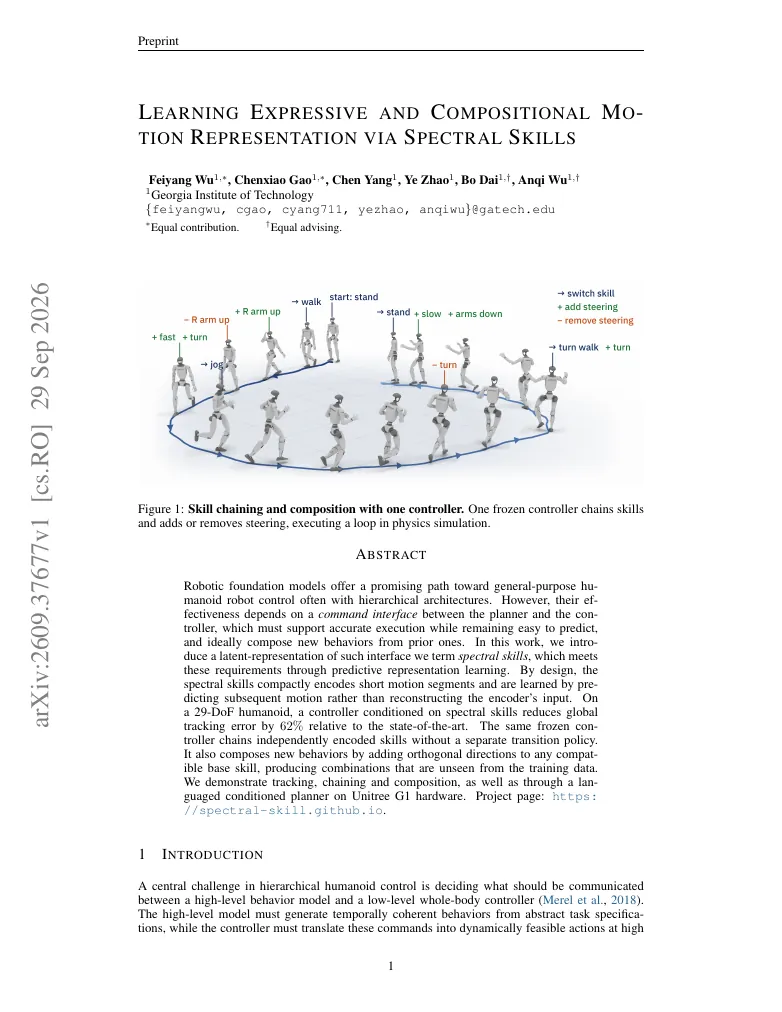
Spectral skills give hierarchical humanoid controllers a compact, compositional command interface.
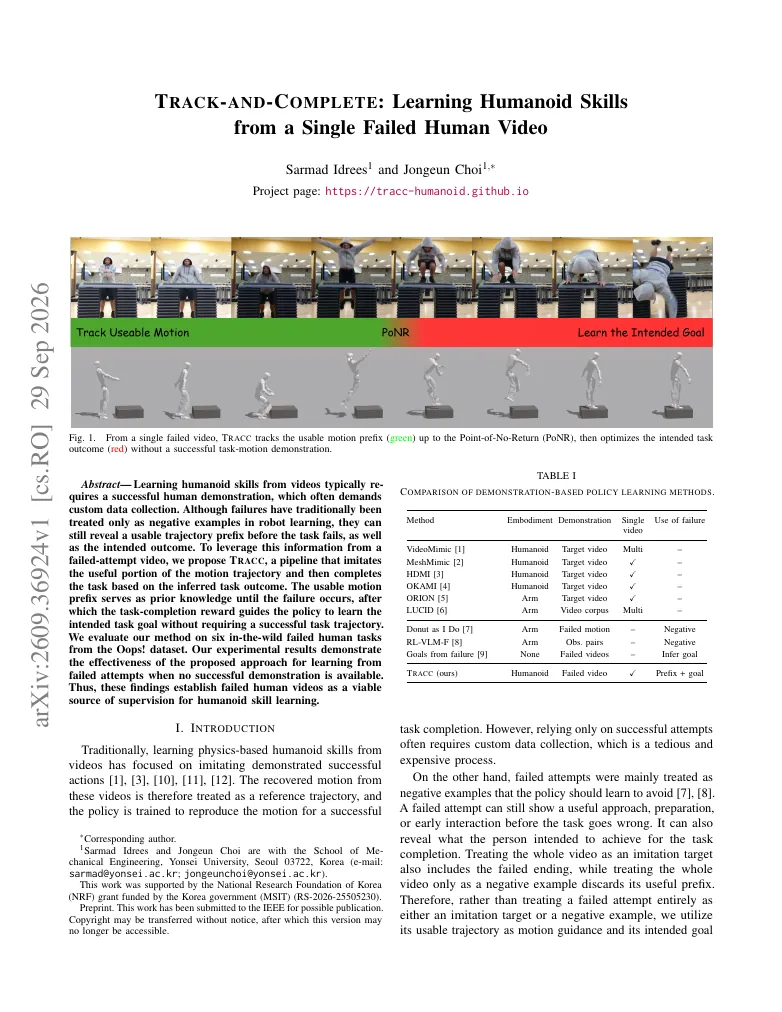
Learn useful humanoid skills from a failed attempt rather than requiring a successful demonstration.
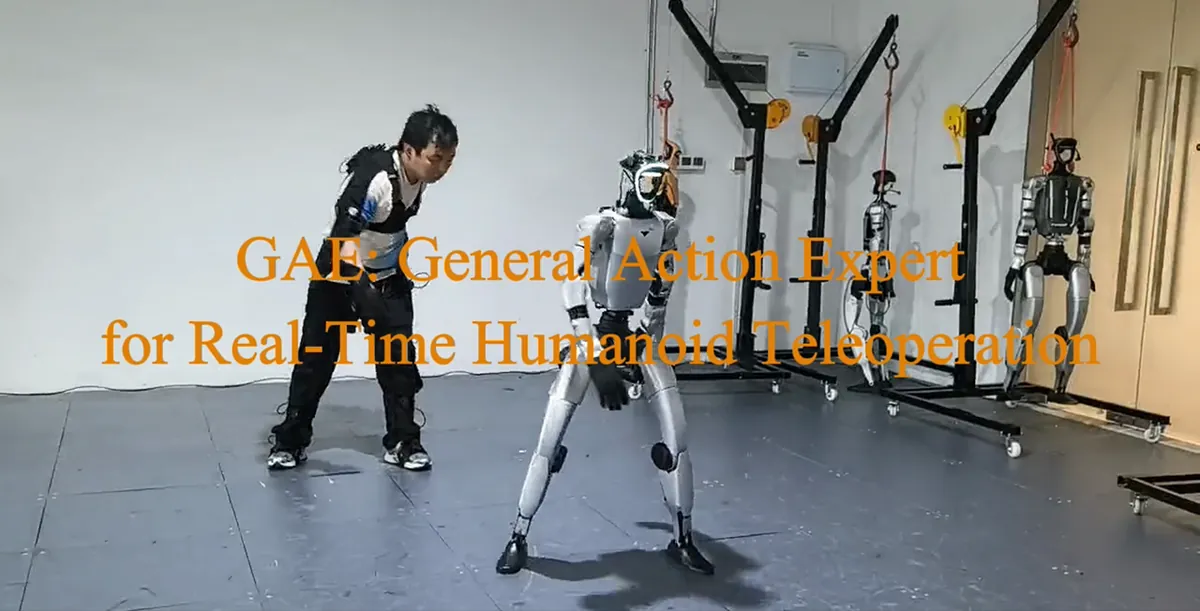
Low-latency whole-body humanoid teleoperation across diverse human behaviors.
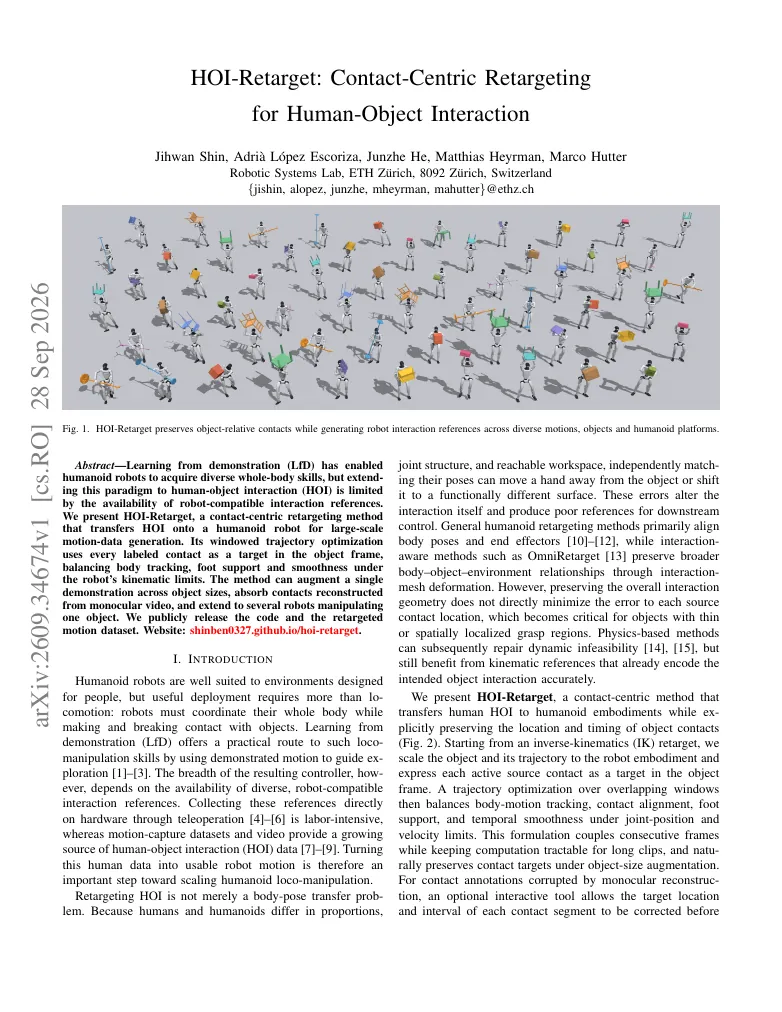
Generate robot-compatible humanoid interaction references using contact-centric motion retargeting.
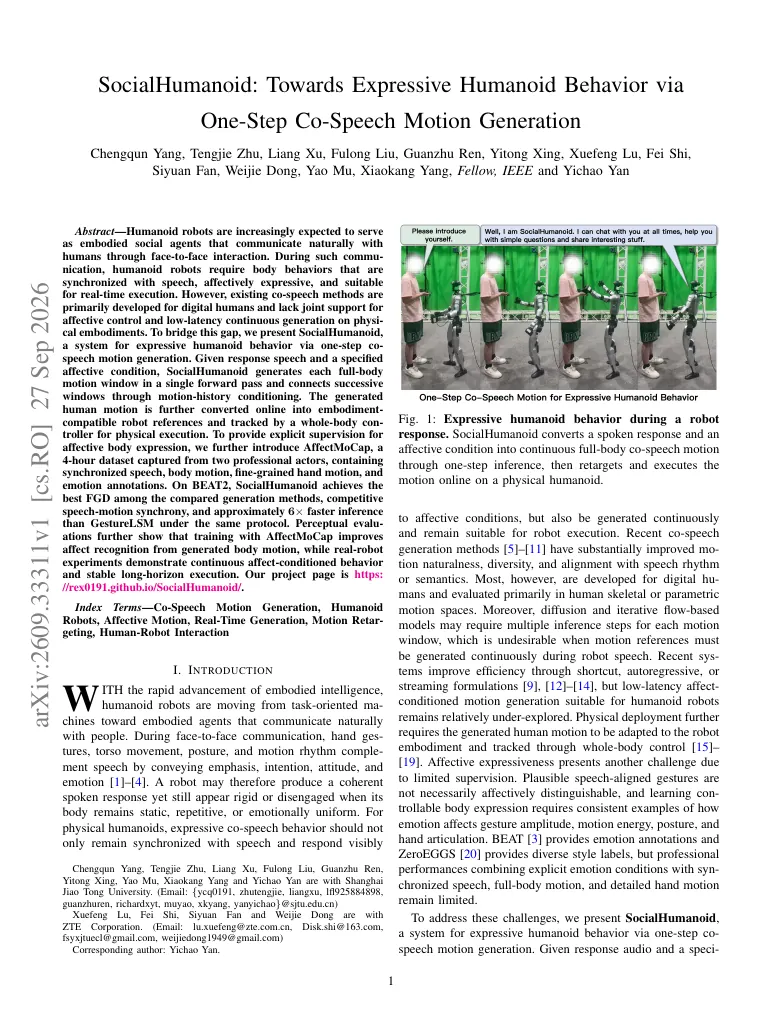
Generate speech-synchronized affective whole-body motion for continuous physical humanoid execution.
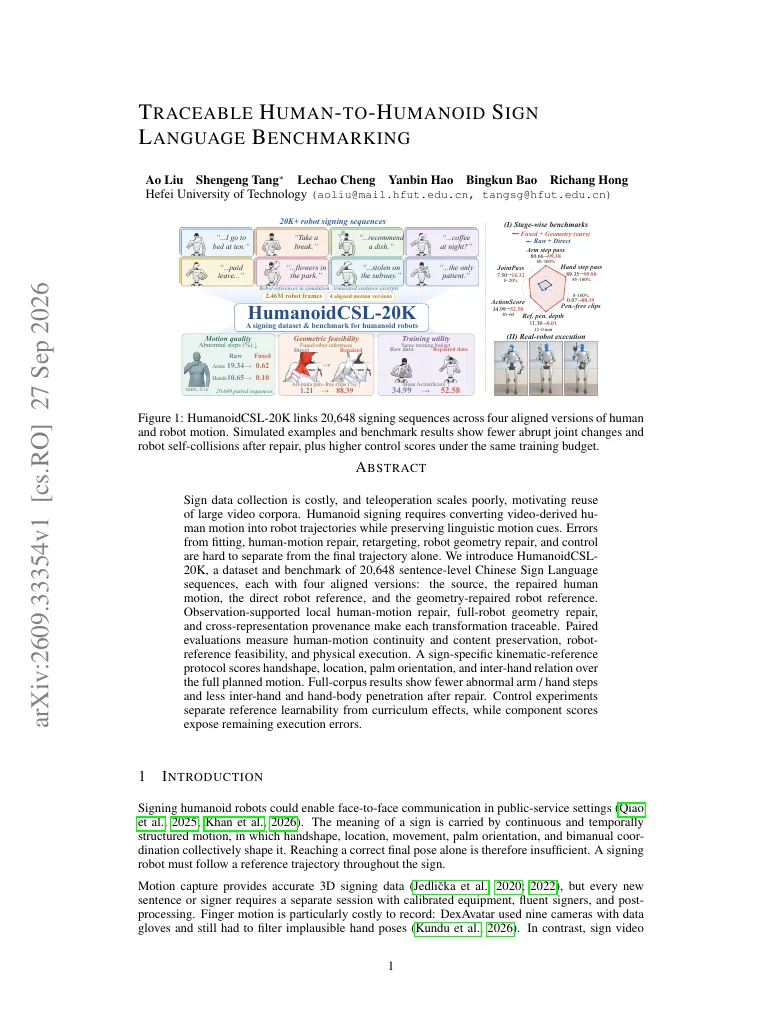
Trace repairs and retargeting through a 20,648-sequence humanoid sign-language dataset and benchmark.
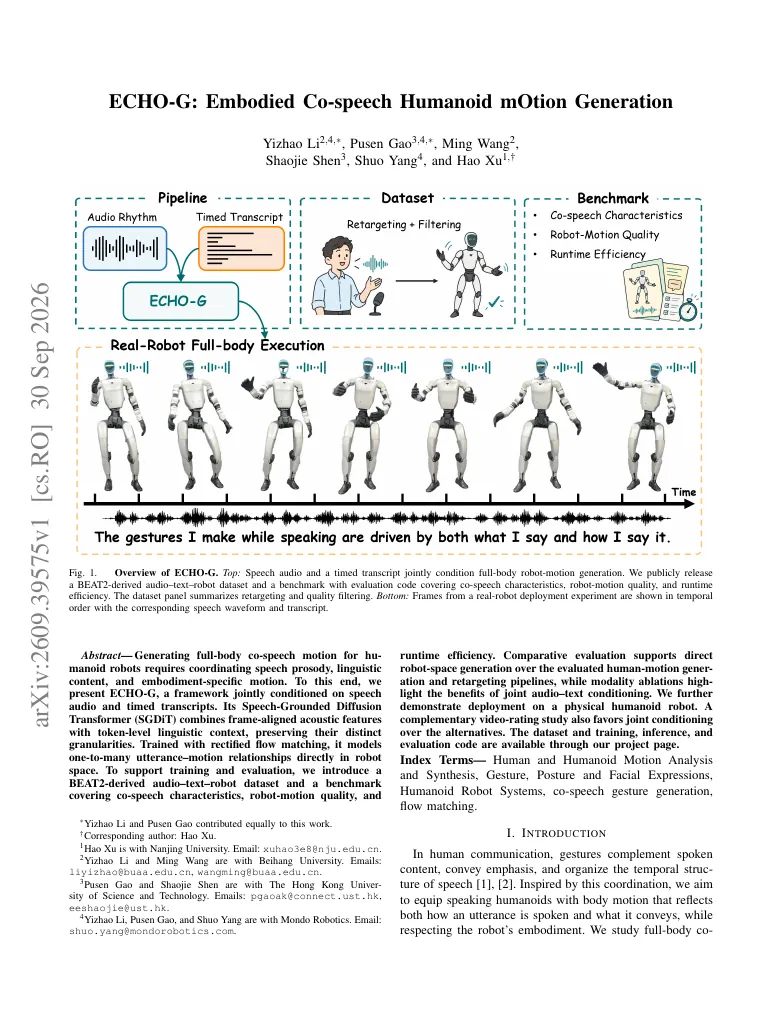
ECHO-G generates full-body co-speech motion for humanoids directly in robot space using joint audio-text conditioning.
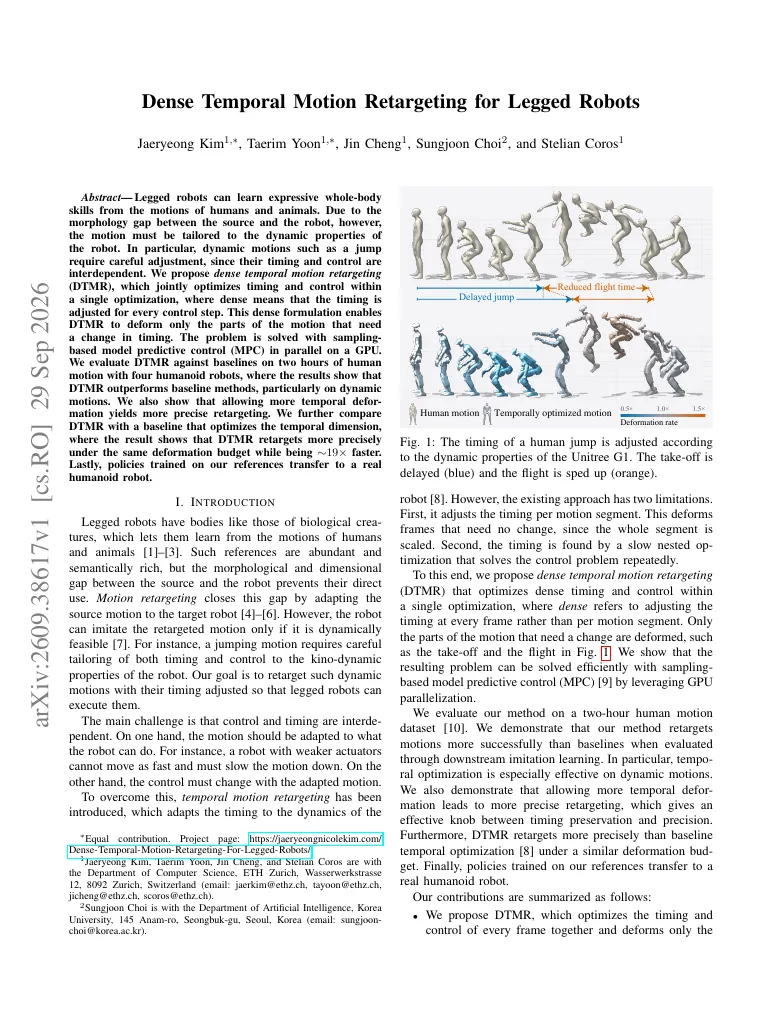
Dense temporal motion retargeting (DTMR) jointly optimizes timing and control via sampling-based MPC for legged robots.
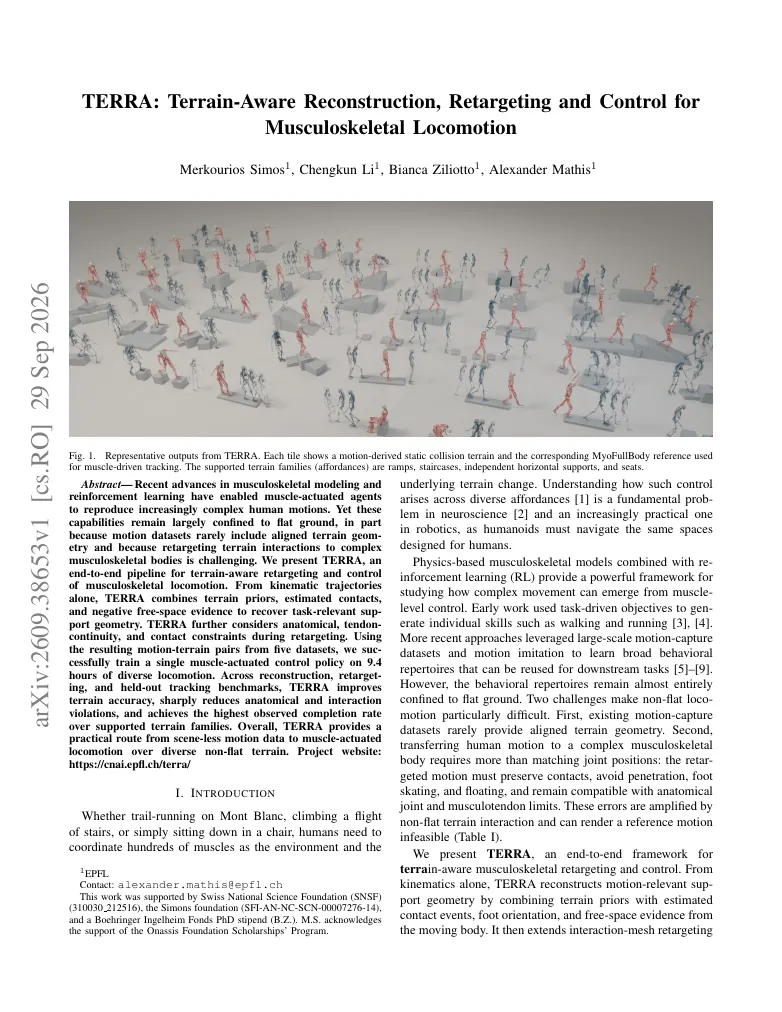
TERRA reconstructs support terrain from scene-less motion, retargets it to a 354-muscle body, and trains one terrain-spanning locomotion policy.
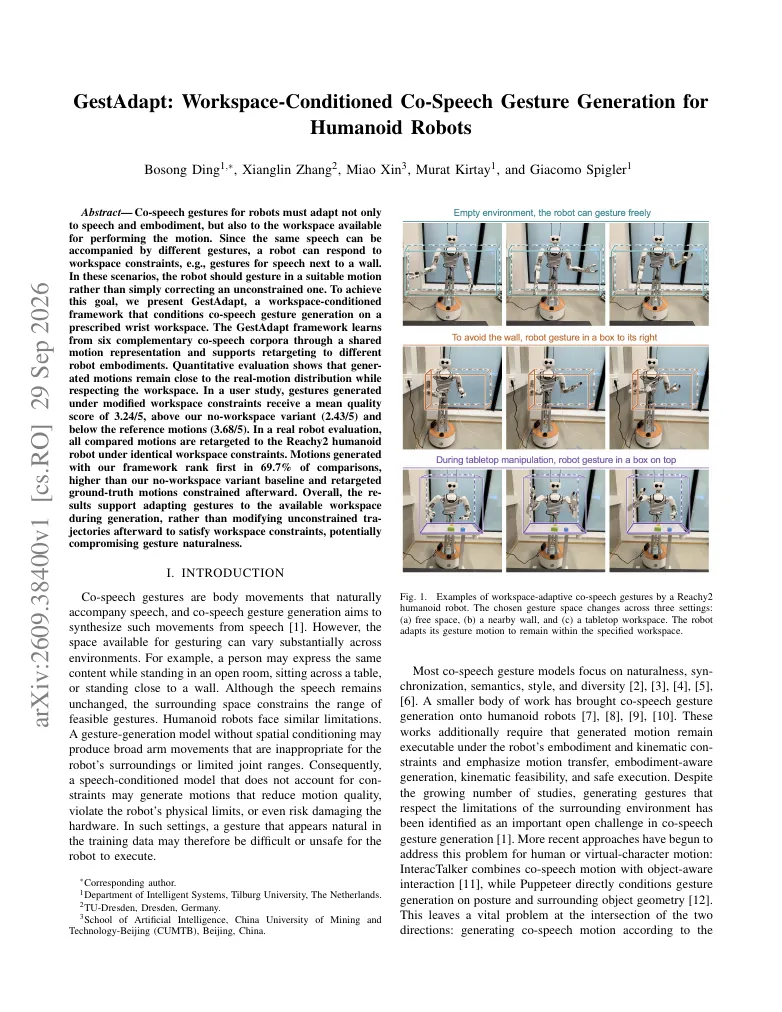
Speech-to-motion diffusion generates workspace-aware gestures in a shared representation, then retargets them under physical constraints to G1, GR3, and Reachy2 humanoids.
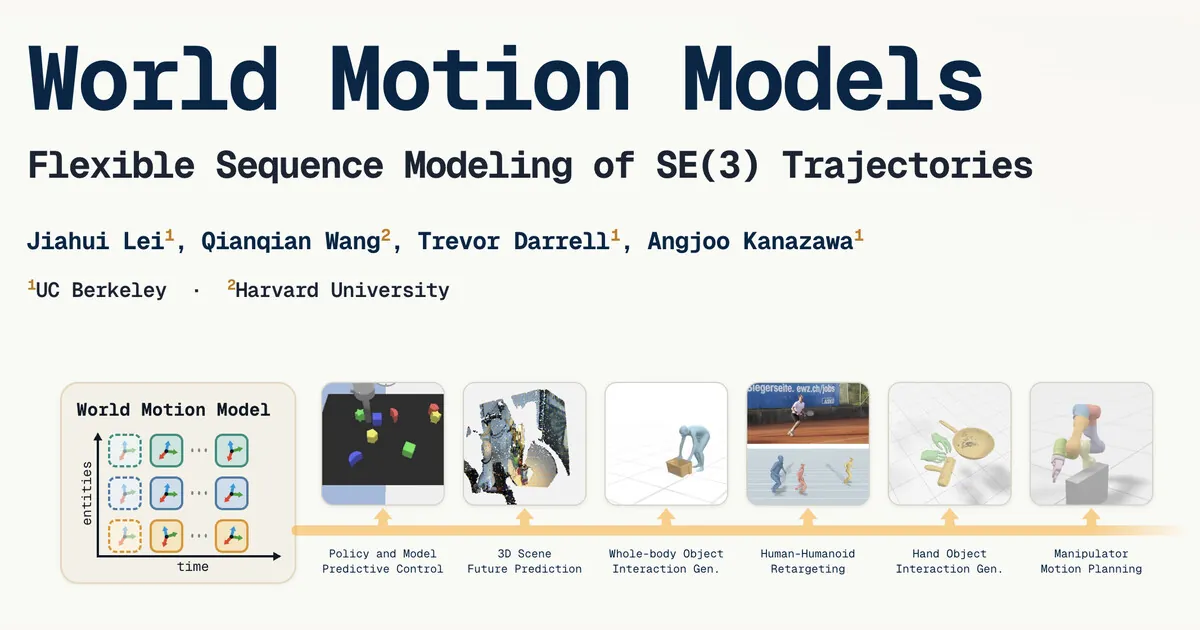
WMMs model dynamic 3D scenes as sparse SE(3) pose trajectories using flow-matching with per-token noise for any-to-any conditioning.
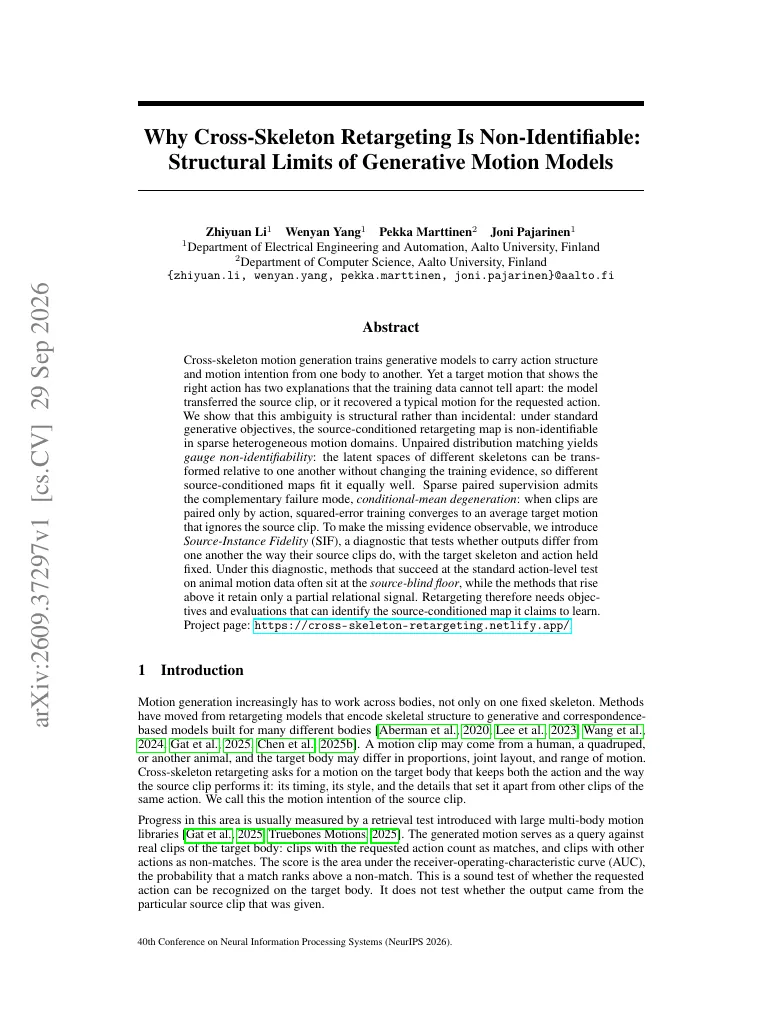
Retargeting identifiability analysis and Source-Instance Fidelity diagnostic, with paired human-to-G1 and LAFAN1-to-six-humanoid studies beyond the abstract's animal-motion evaluation.
Whole-body task contact: feet, torso, hands, and objects.
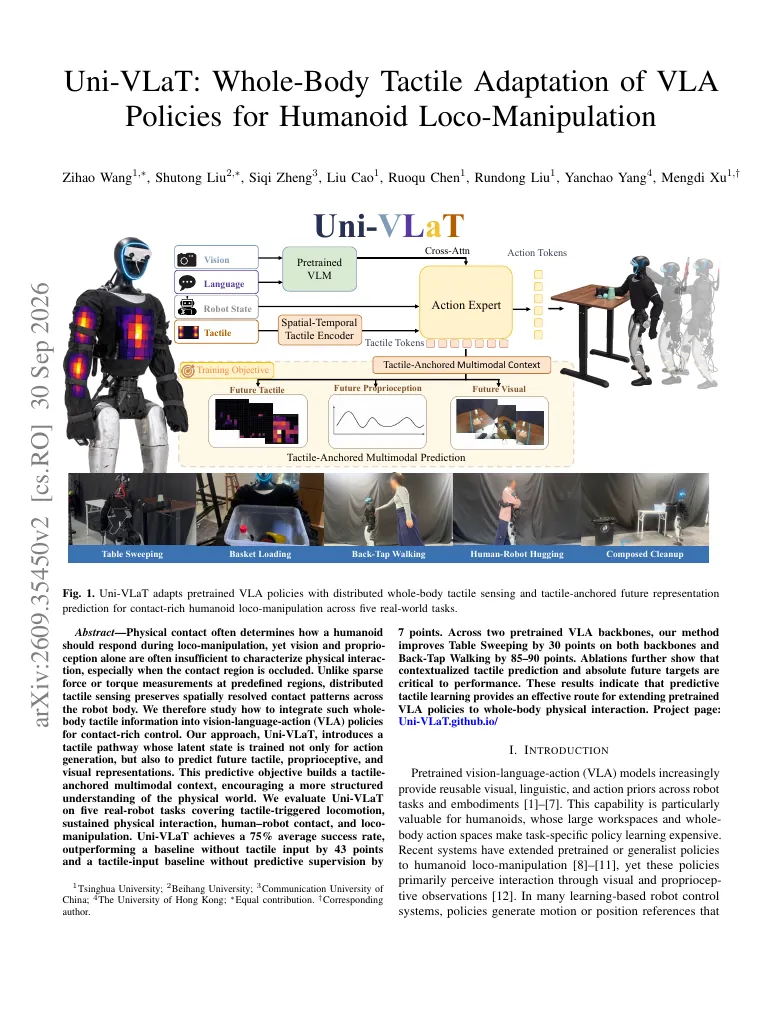
Whole-body tactile adaptation of VLA policies for humanoid loco-manipulation.
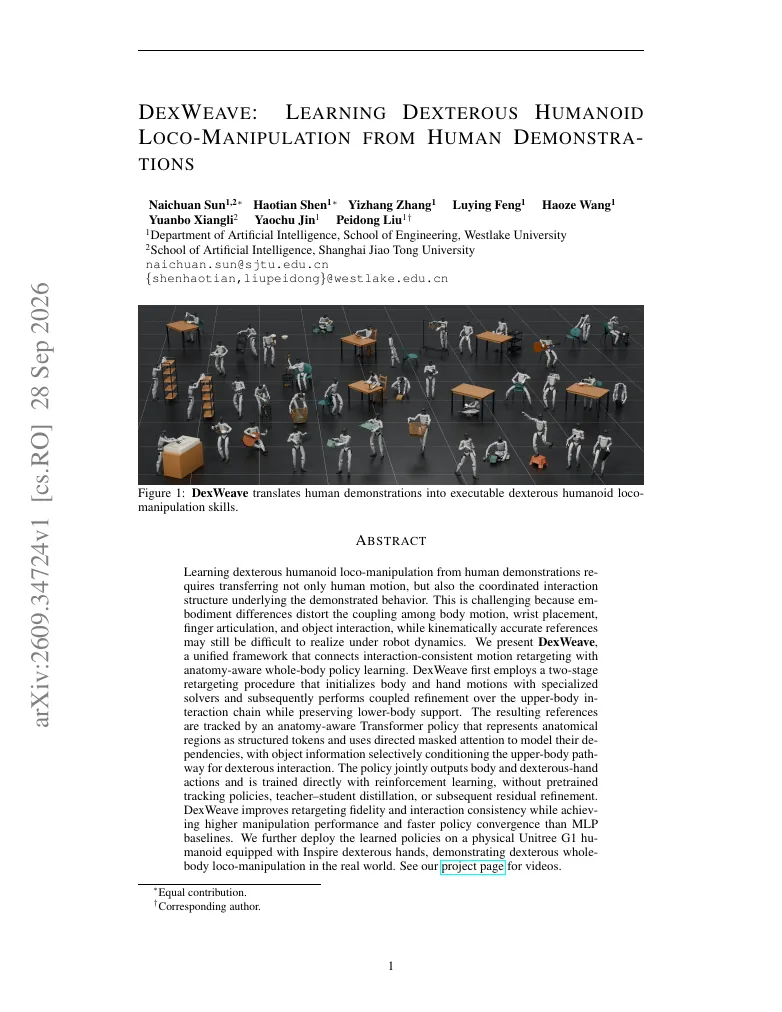
Learning dexterous humanoid loco-manipulation from human demonstrations.
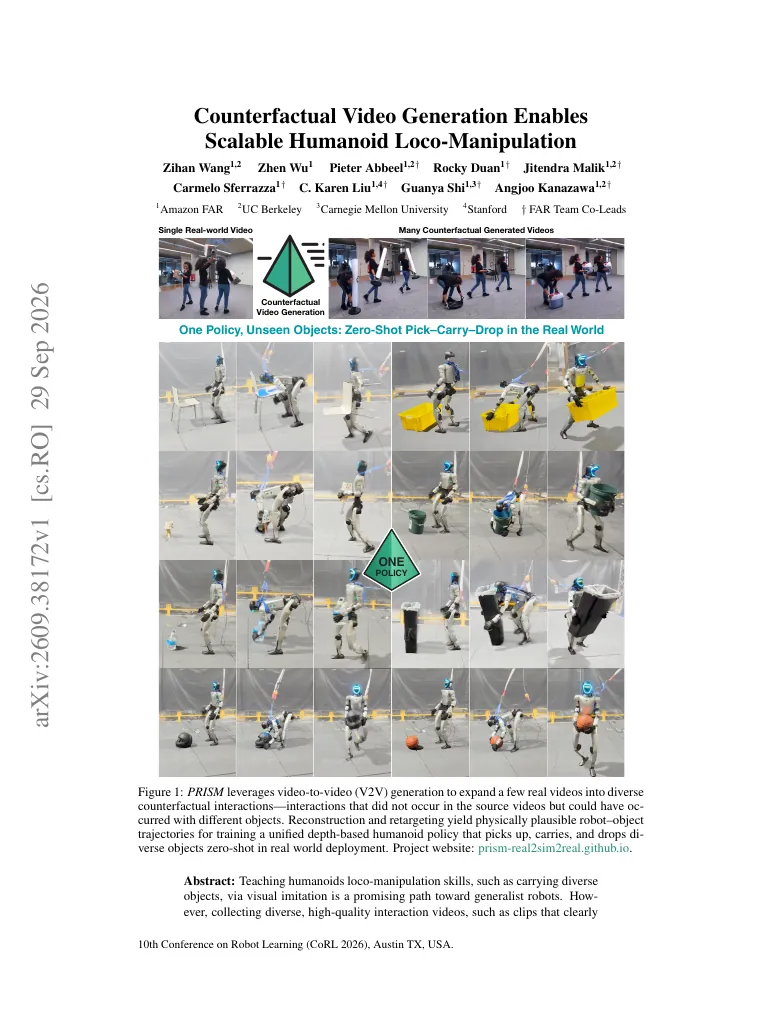
PRISM expands a few human interaction videos into counterfactual training data for depth-conditioned humanoid pick-carry-drop policies.
Construct robot-compatible action and state supervision from egocentric human demonstrations without physical-robot demonstrations.
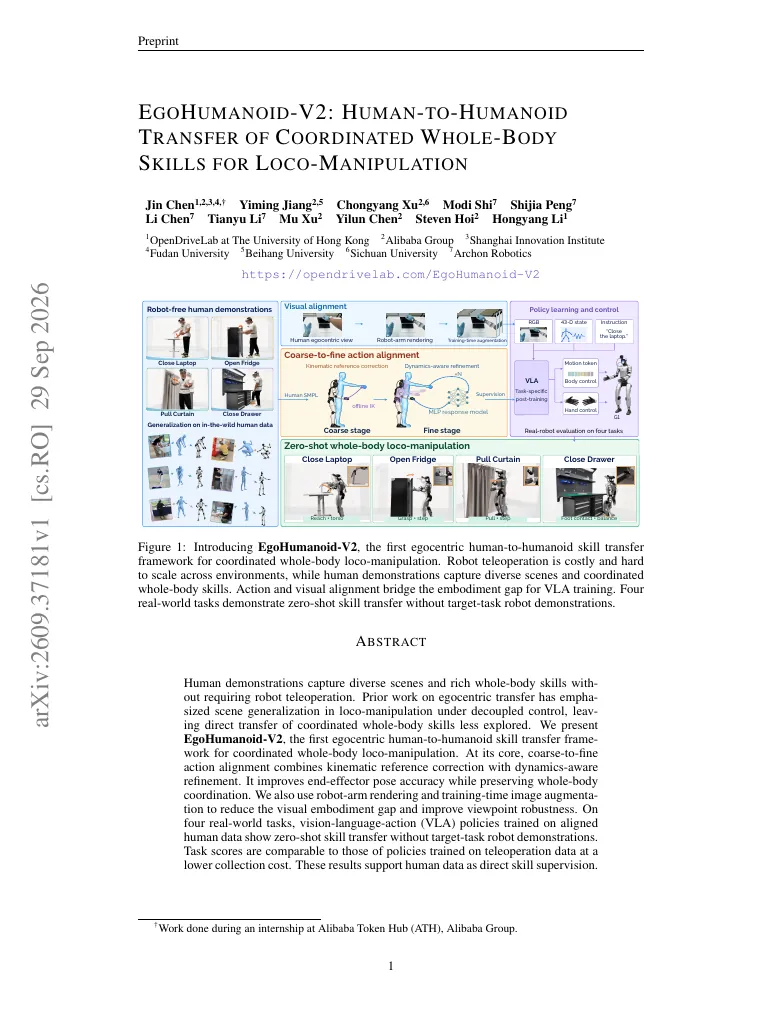
Transfer coordinated whole-body skills directly from egocentric human demonstrations to humanoids.
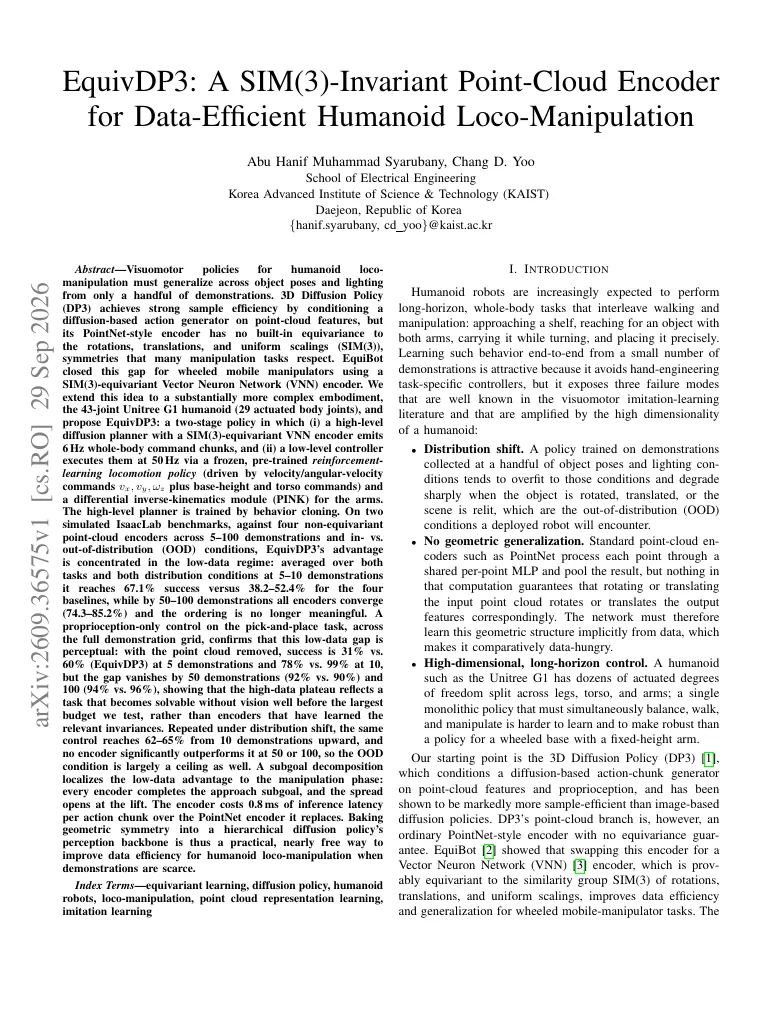
Geometric equivariance improves low-demonstration humanoid diffusion policies.
Add task-specific contact behavior between a trajectory source and an unmodified whole-body tracker.
Surface-contact OT plus constrained IK jointly retarget G1 and object paths at native scale; 87% OMOMO contact Jaccard and 6/8 single-clip hardware trials.
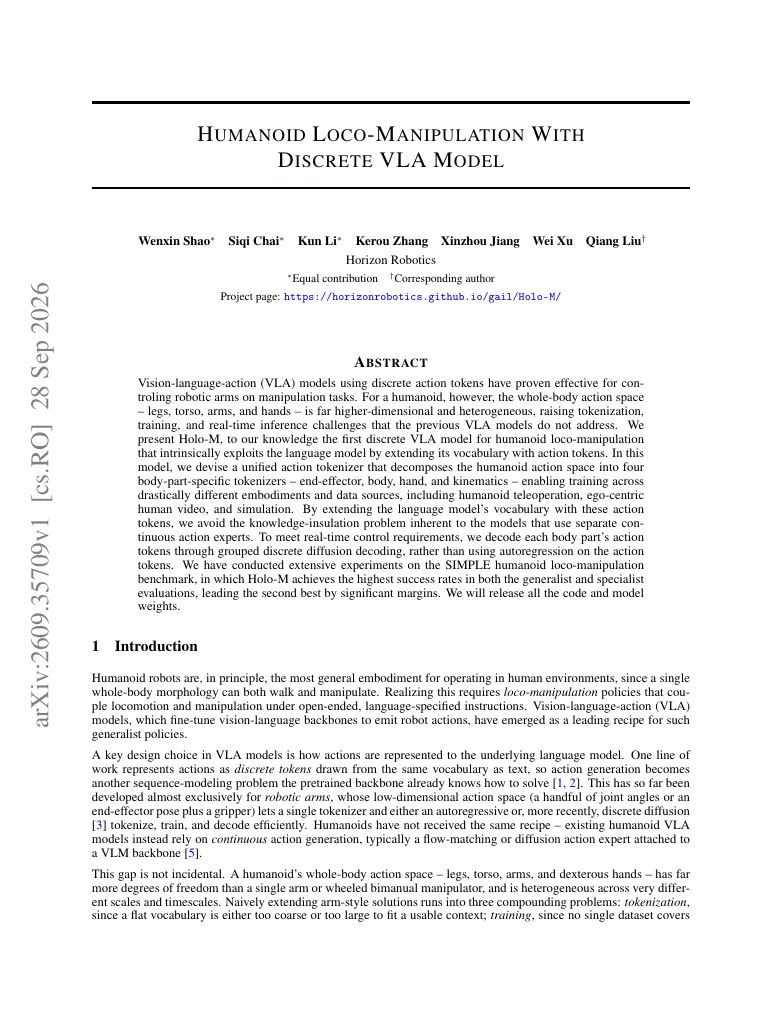
Holo-M extends a language model vocabulary with discrete whole-body action tokens for humanoid loco-manipulation.
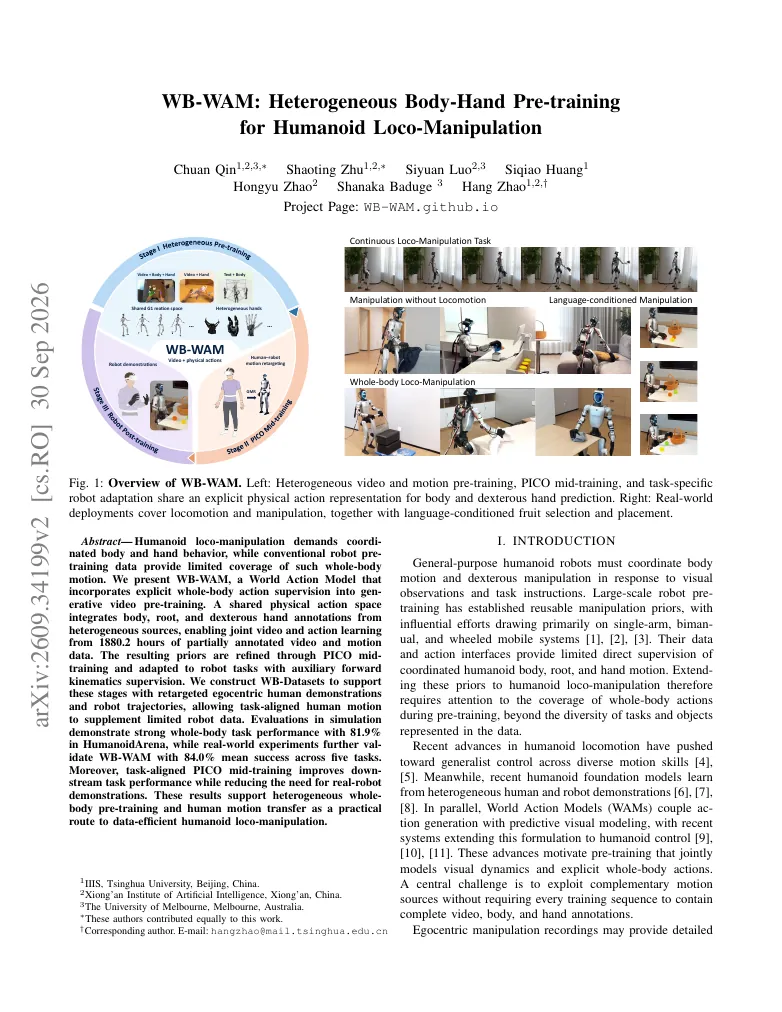
Joint video/action pre-training learns whole-body humanoid priors from heterogeneous partially annotated data.
Use an LLM to design closed-loop high-level humanoid policy code over a frozen whole-body controller.
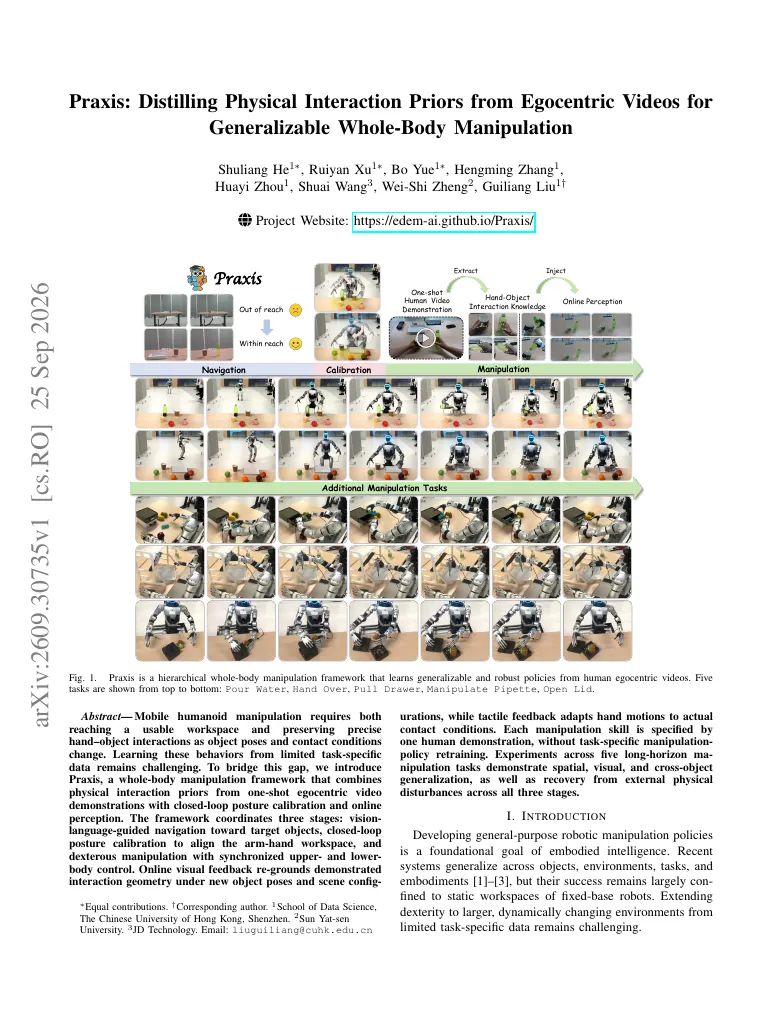
Combine one-shot human video priors with posture calibration and feedback for whole-body humanoid manipulation.
Directional/tunable EE and root compliance via hierarchical RL for humanoid interaction.
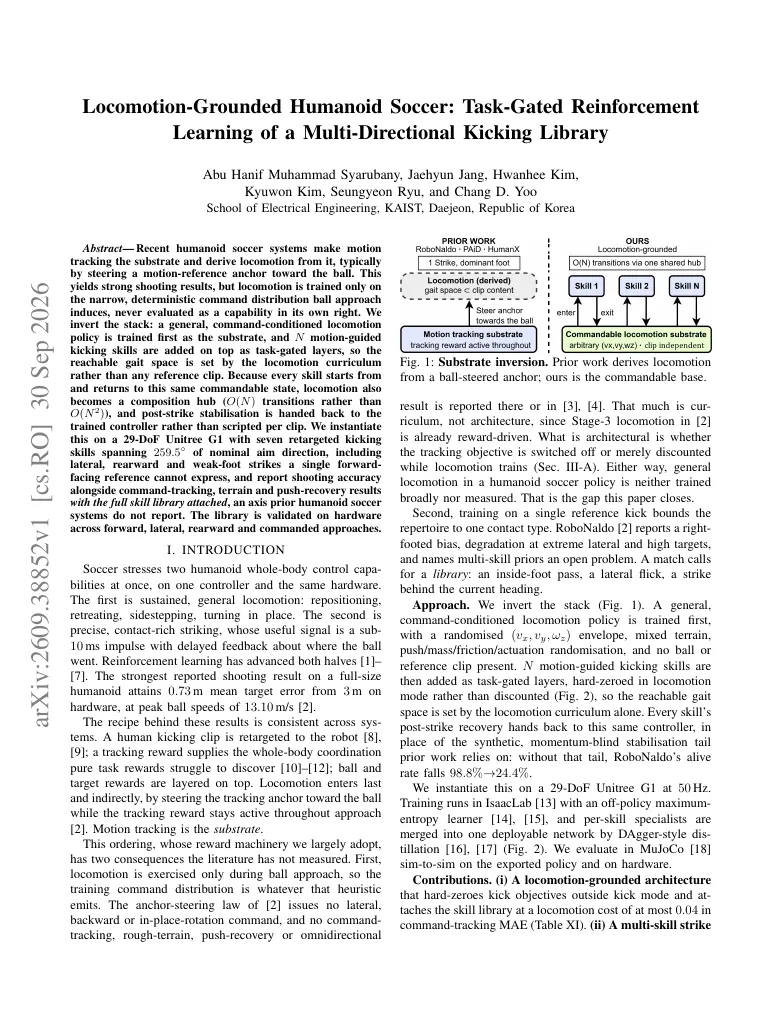
A locomotion-first, task-gated Unitree G1 controller layers seven directional kicking skills onto an omnidirectional gait substrate.
Open Isaac Lab benchmark coupling Unitree G1 ladder positioning and climbing with fragile-payload bulb replacement and disposal across one long-horizon episode.
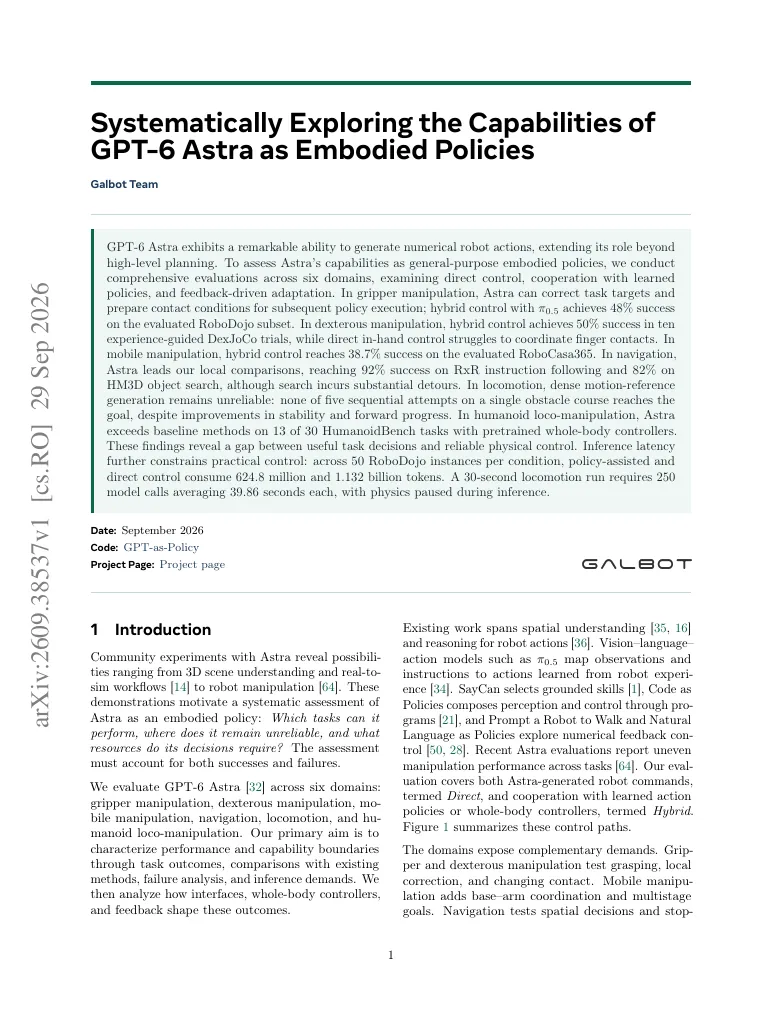
A broad benchmark study probes GPT-6 Astra's direct and controller-mediated robot actions, including dense humanoid locomotion and whole-body loco-manipulation.
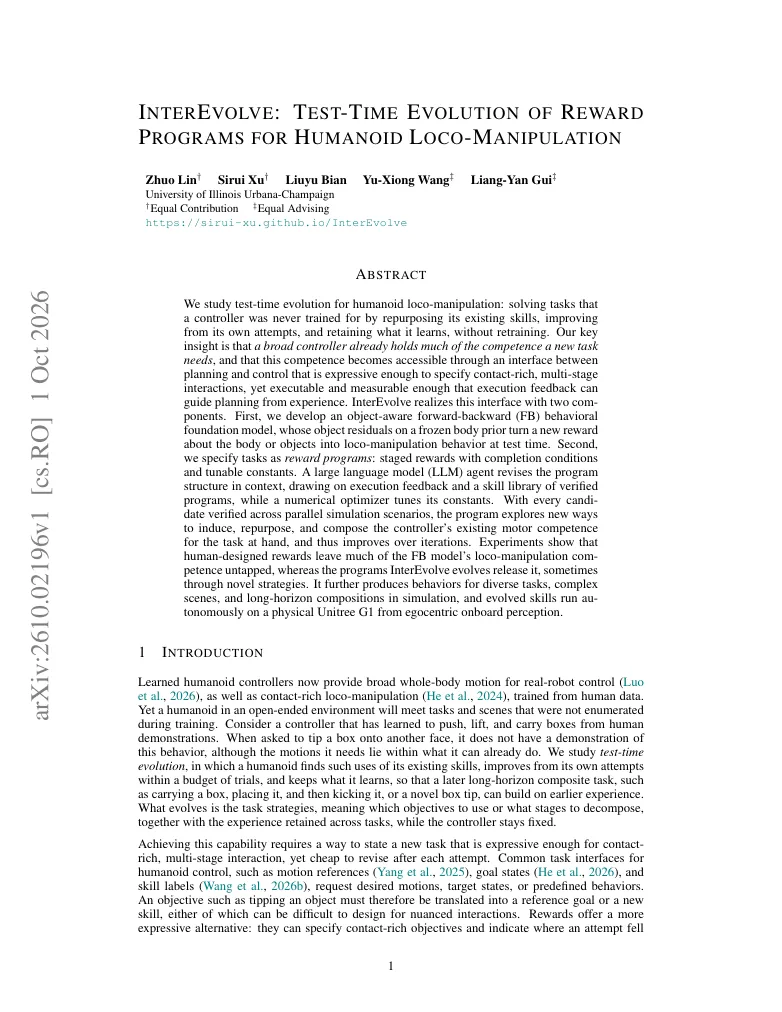
Test-time evolution of staged reward programs executed by a fixed object-aware FB behavioral foundation model on frozen humanoid controller.
18-task benchmark evaluating humanoid tool selection and execution across L0/L1/L2 levels and standard/decoy tool sets on Unitree G1.
MASkillBlender learns a shared decentralized high-level policy that blends fixed single-humanoid primitive skills for multi-humanoid coordination using only task-level rewards and local obs...
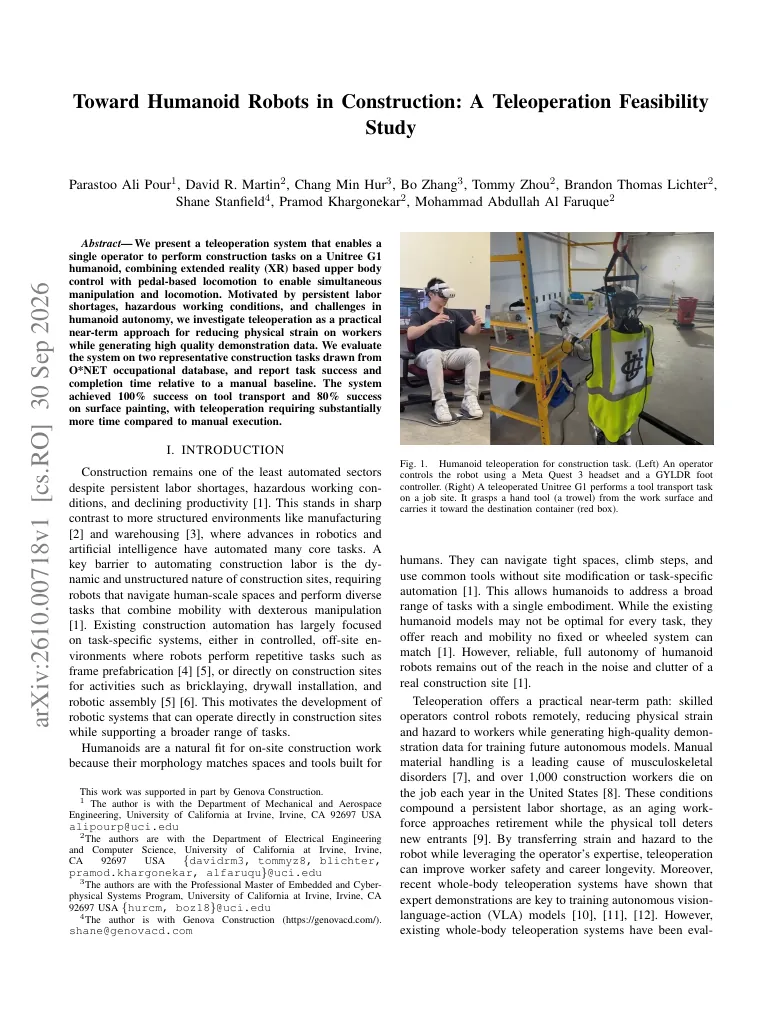
Teleoperation system for Unitree G1 using XR upper-body control and pedal locomotion for construction tasks.
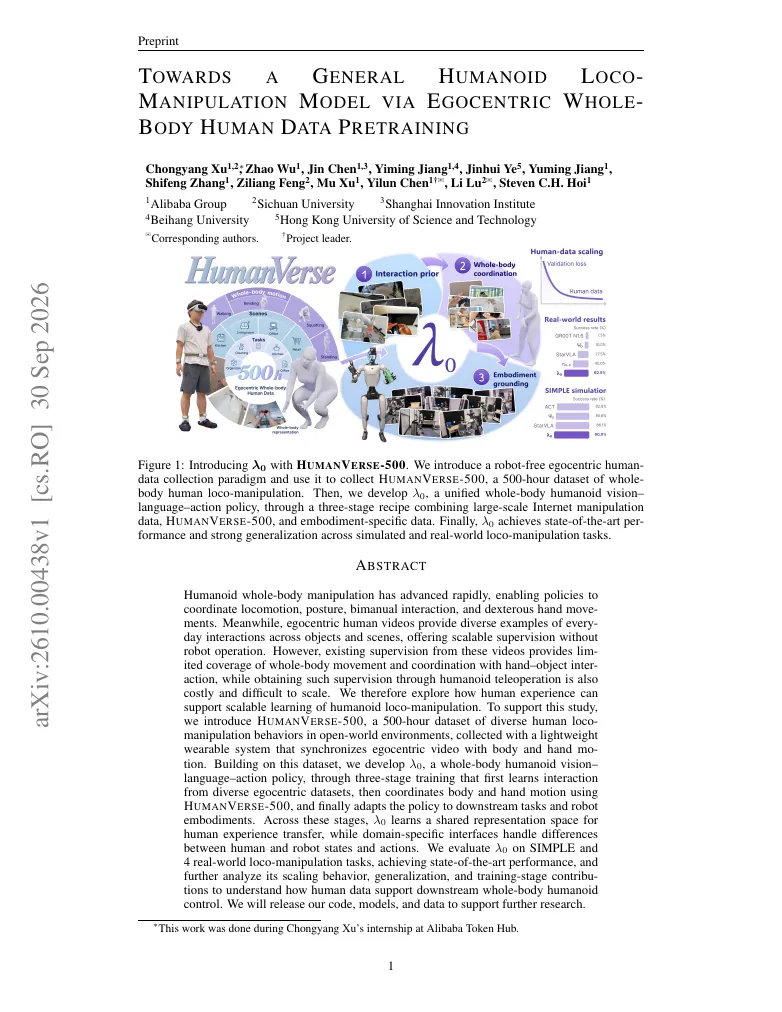
λ0 policy pretrained on egocentric human data then adapted to Unitree G1 loco-manipulation via three-stage training.
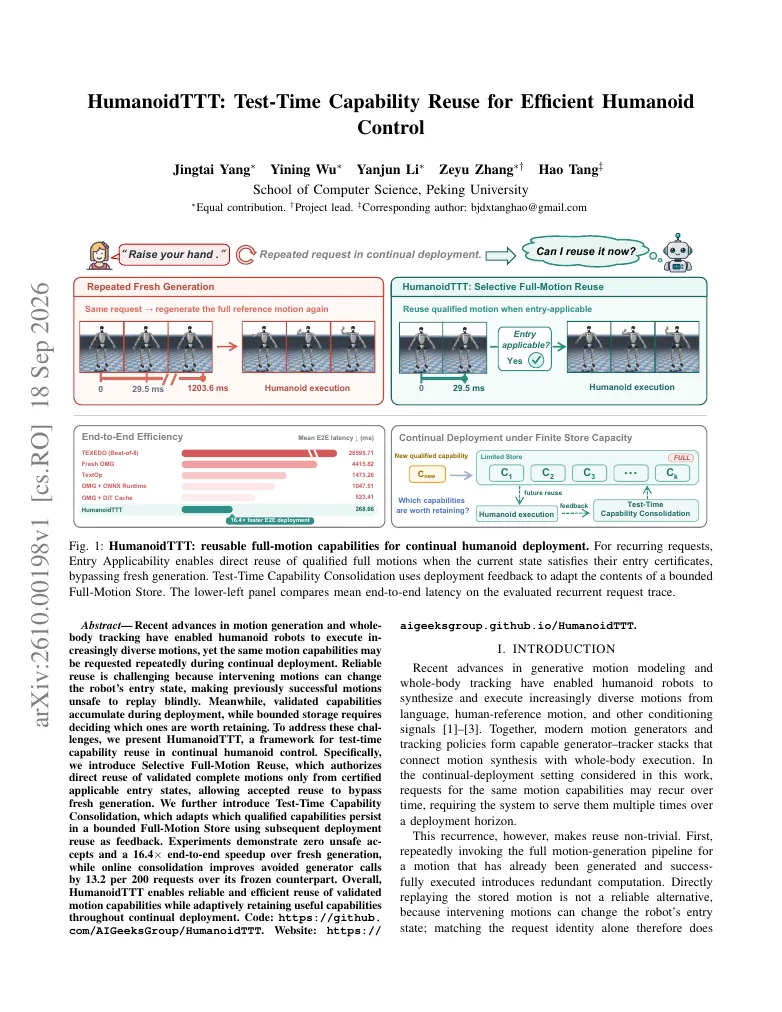
HumanoidTTT reuses validated full motions on Unitree G1 only from certified entry states and consolidates the store online.
MPC, impedance, safety layers, and whole-body coordination.
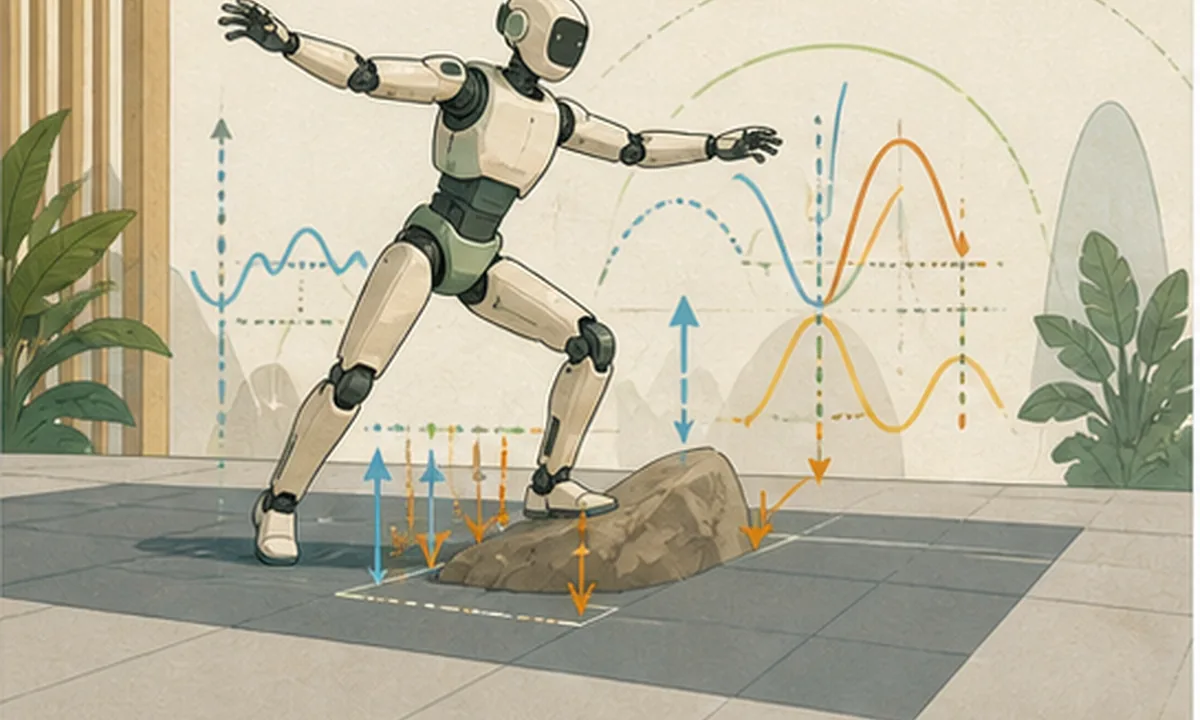
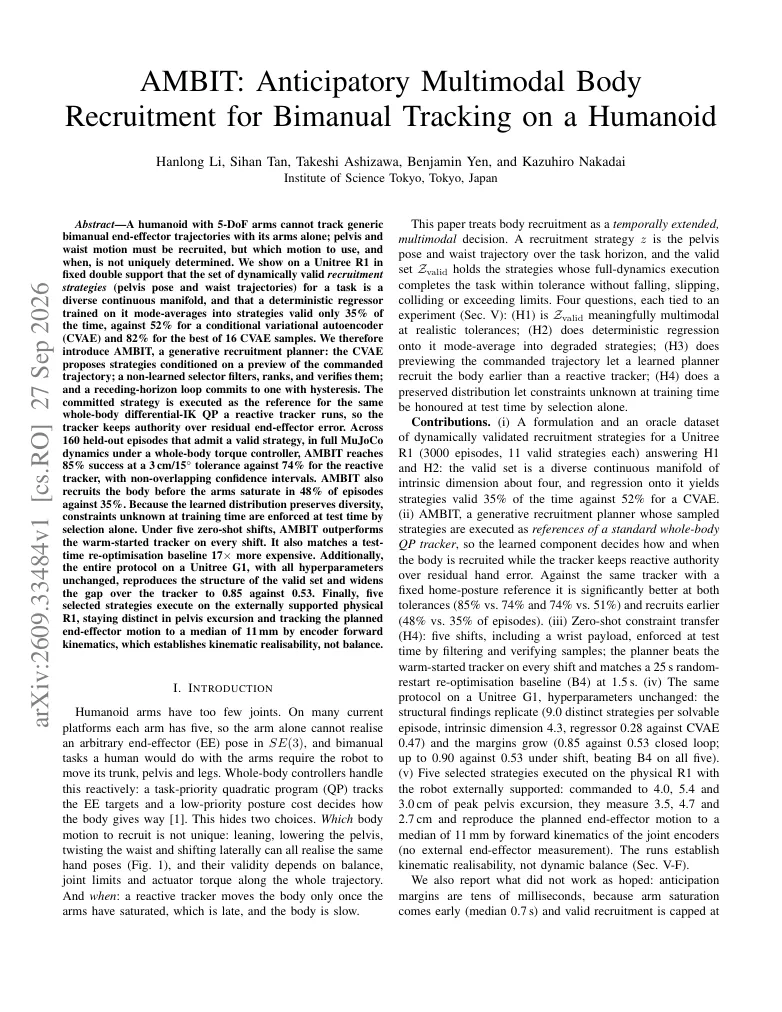
Recruit pelvis and waist motion before underactuated humanoid arms saturate during bimanual tracking.
Whole-body compliance on heavy humanoids with lower-body engagement under arbitrary-site forces.
Benchmarks, datasets, rewards, simulators, and tooling.

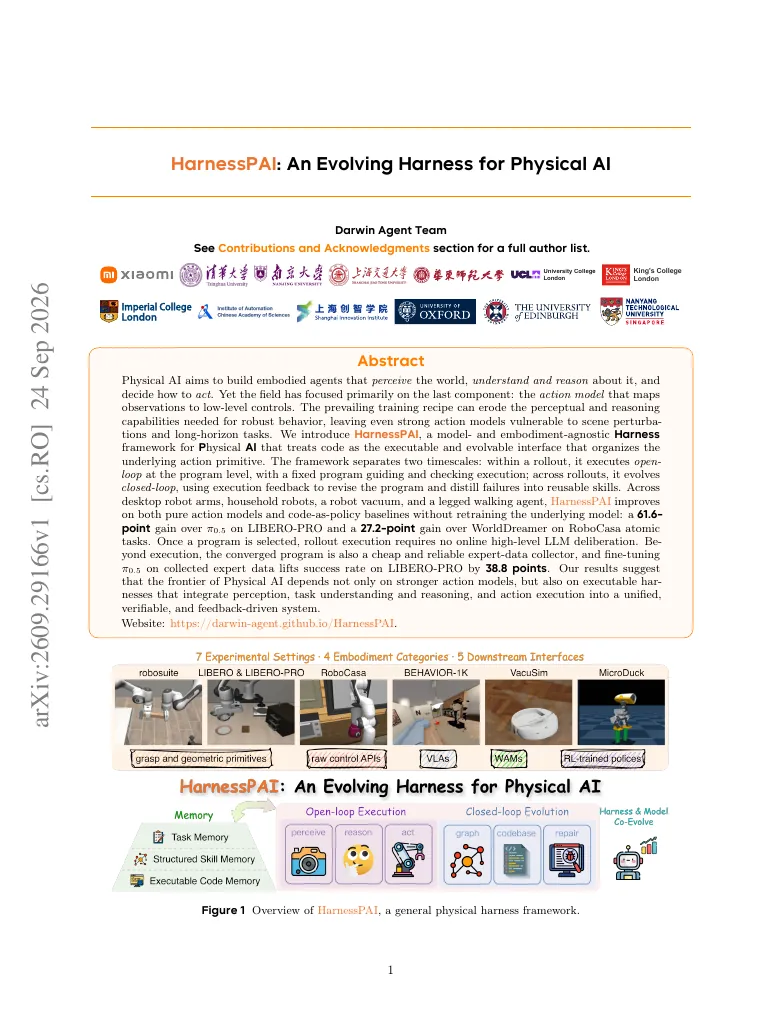
Model- and embodiment-agnostic harness for Physical AI including legged walking agent.
Temporal-distance, arrival-hazard and occupancy critics accelerate self-supervised goal control; simulated Go2 gains, but PPO remains better and G1 walking fails.
Translate observation-only videos into inspectable temporal specifications for robot policy learning.
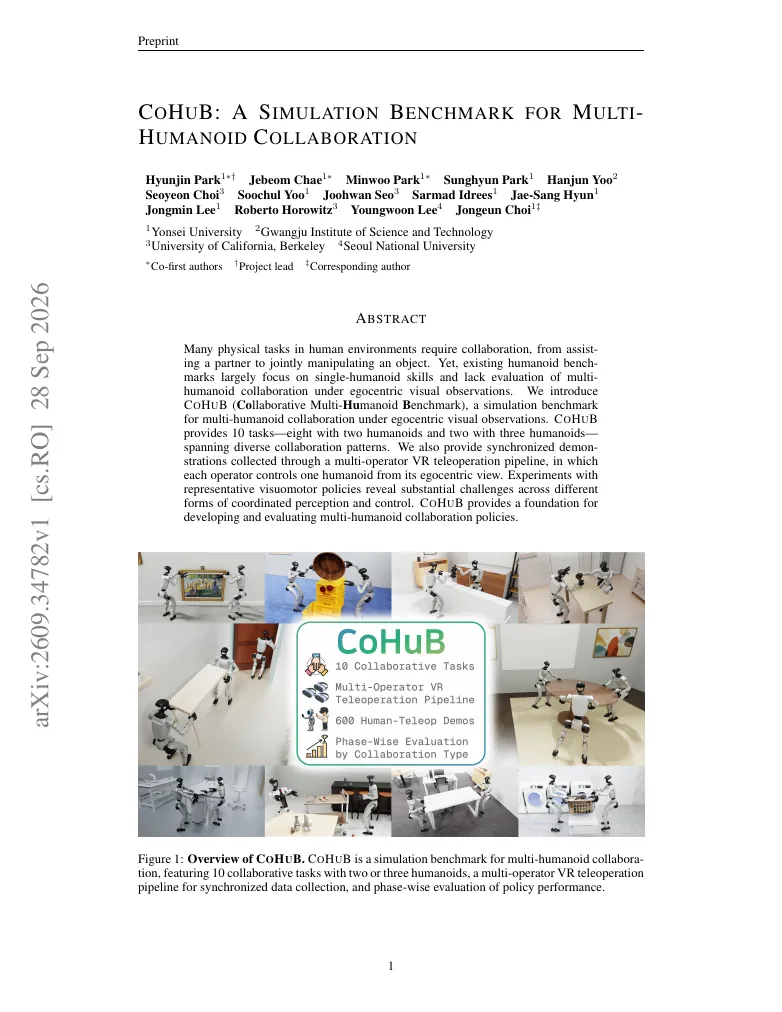
Benchmark multi-humanoid collaboration under egocentric visual observations.
Calibrate an opaque quadruped velocity interface using planner-relevant uncertainty reduction.
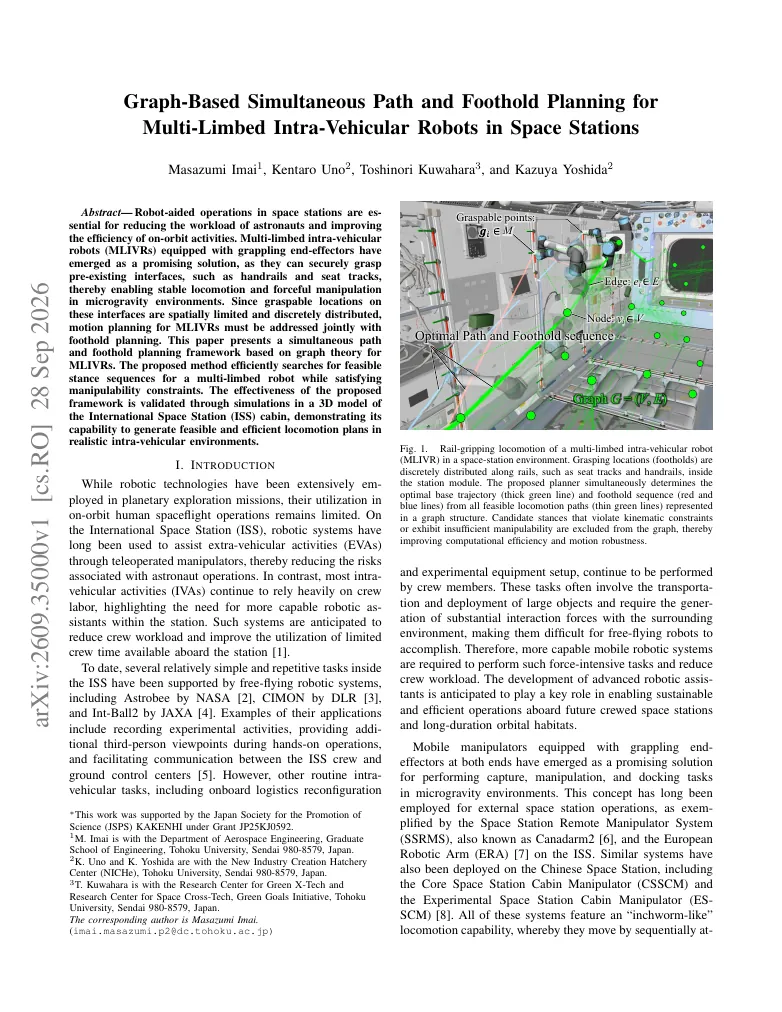
Jointly plan paths and discrete footholds for multi-limbed robots locomoting through space-station interiors.
Compile consistent mechanical interfaces for closed-chain robot control and simulation.
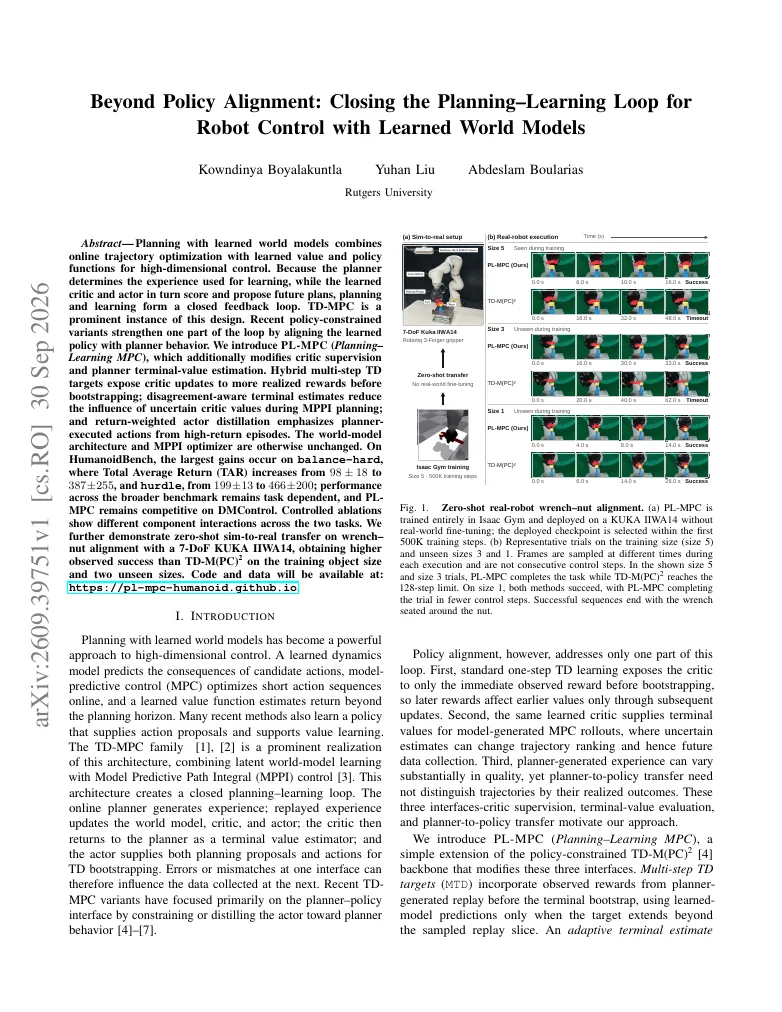
PL-MPC improves learned-world-model control at the critic, planner-terminal, and planner-to-policy interfaces.
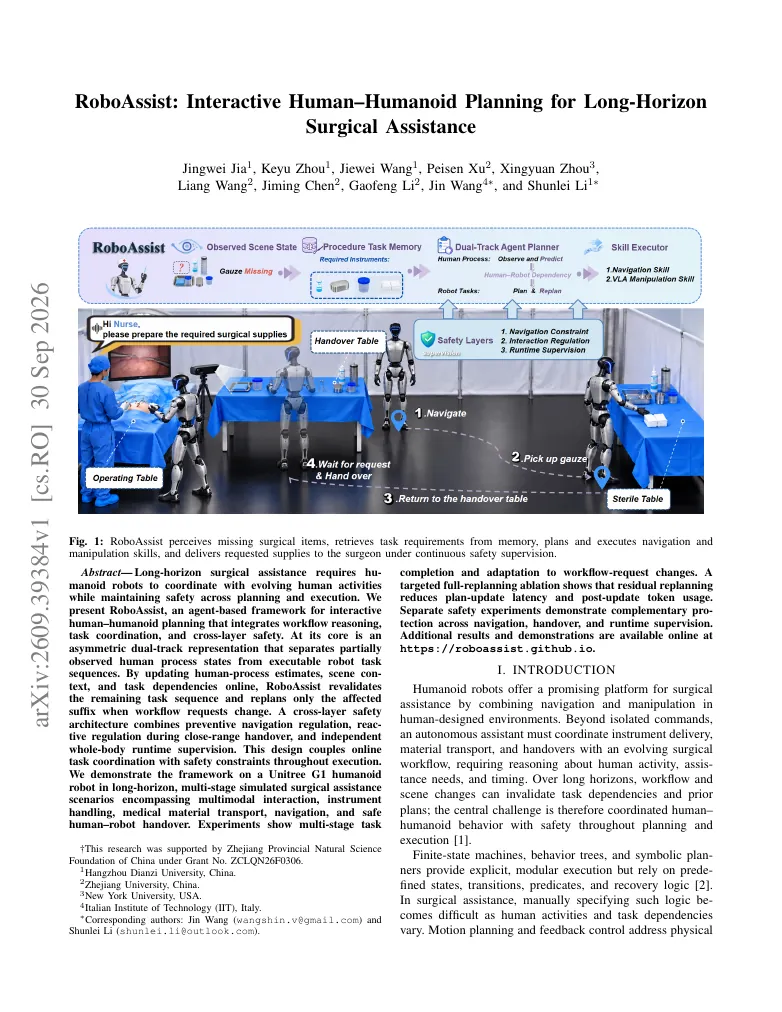
Interactive humanoid surgical-assistance planning links evolving workflow evidence to executable loco-manipulation tasks and layered runtime safety.
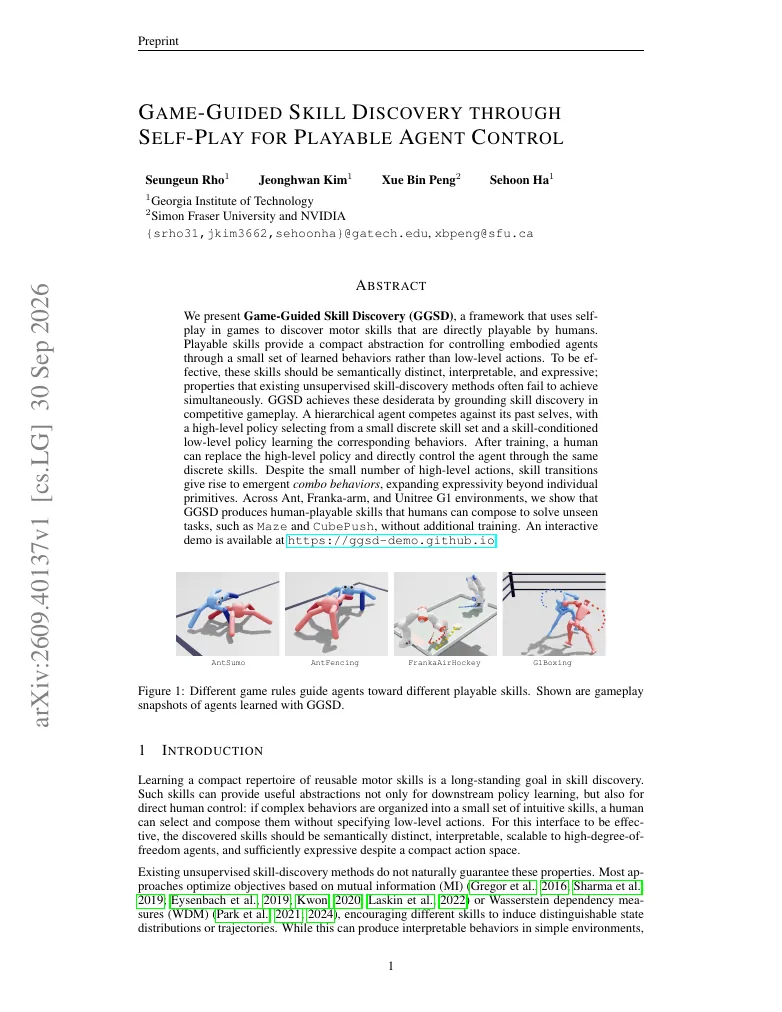
Hierarchical self-play discovers a compact set of interpretable, human-playable motor skills, including locomotion primitives on a simulated Unitree G1.
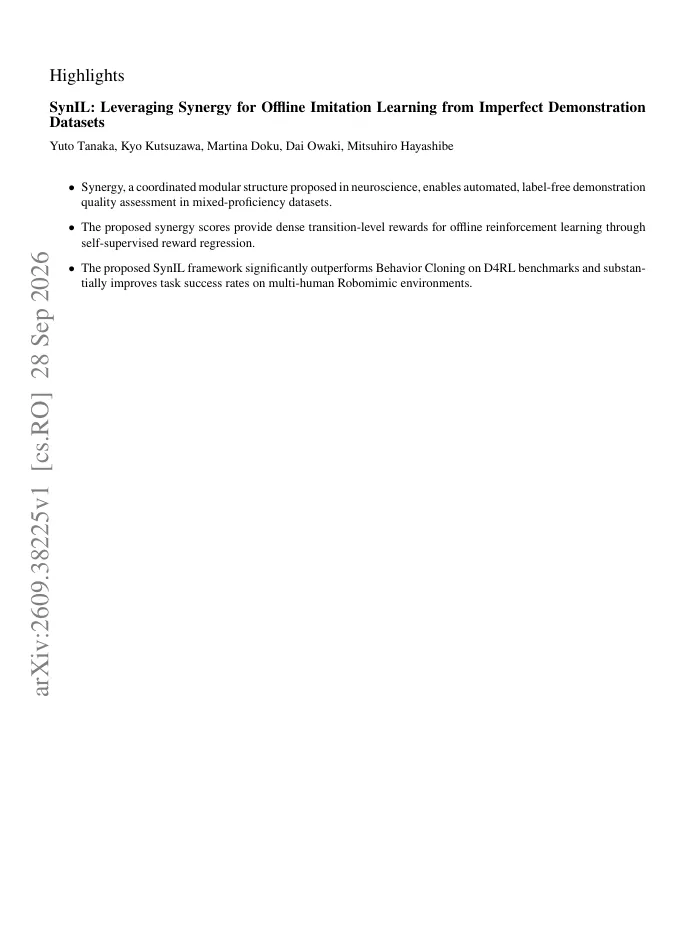
SynIL turns local state-action synergy into dense surrogate rewards for offline imitation from mixed-quality locomotion demonstrations.
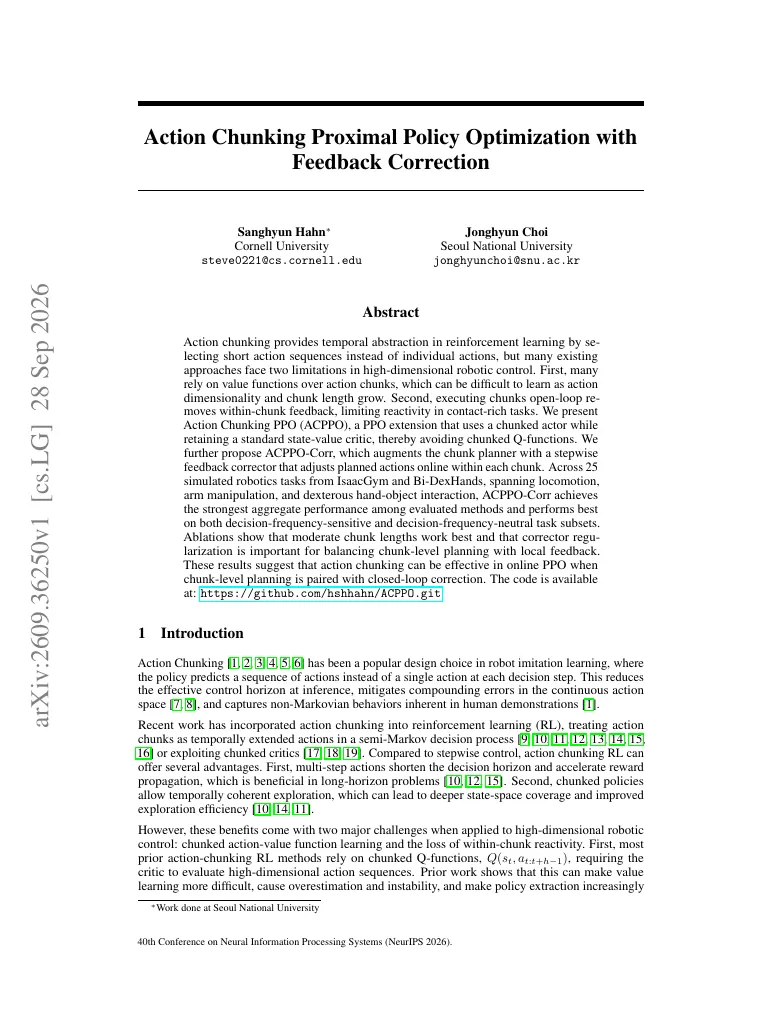
Online PPO training method combines chunk-level action planning with per-step state feedback and is benchmarked on IsaacGym locomotion, including Humanoid.
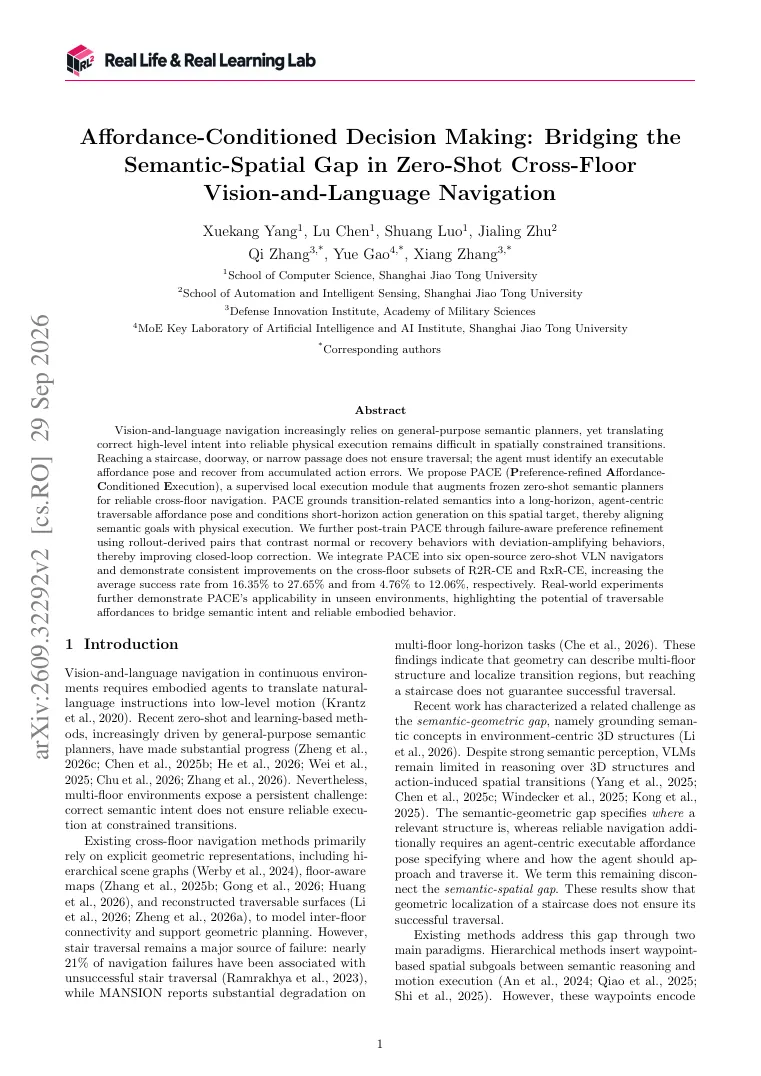
PACE turns semantic staircase intent into executable affordance poses and closed-loop action sequences, materially improving cross-floor navigation and deploying on a Unitree Go2.
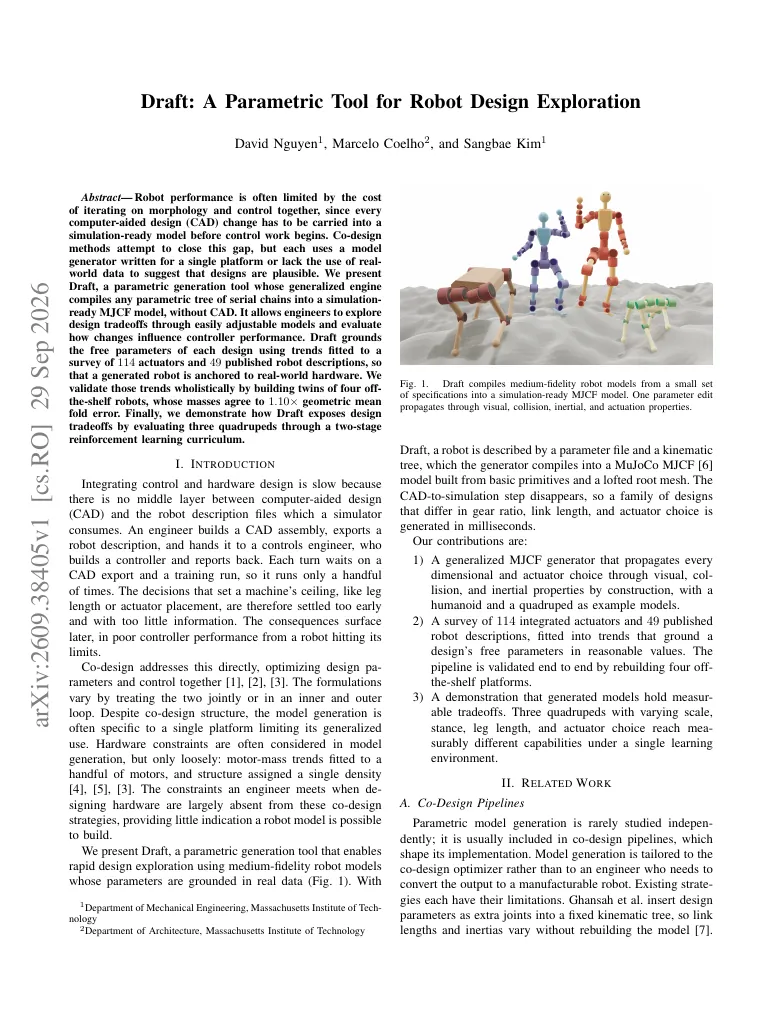
Data-grounded parametric compiler generates simulation-ready legged MJCF models and exposes morphology/control tradeoffs through common PPO locomotion curricula.
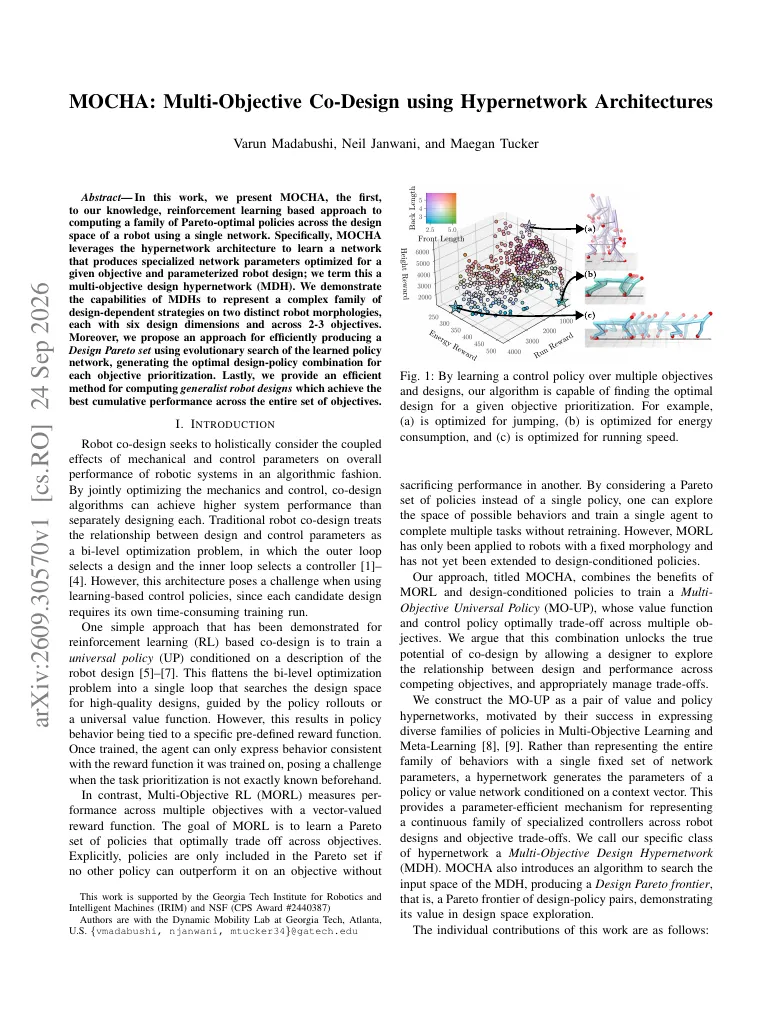
Multi-objective PPO hypernetworks jointly represent locomotion policies across Cheetah/Walker morphology and objective spaces, enabling Pareto and generalist design search from one trained...
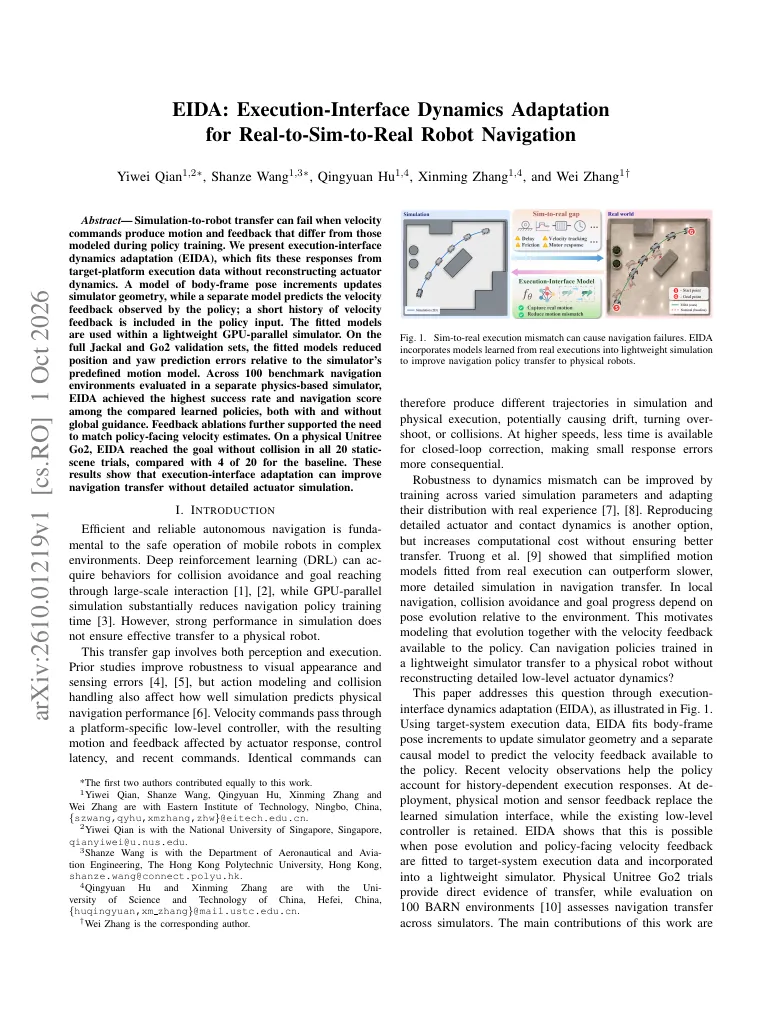
EIDA fits pose-increment and velocity-feedback models from target-platform data and uses them inside a lightweight simulator for navigation policy training.
Crossed audit separating the scorer and proposal-generator roles of world models inside CEM planning on Walker and Cheetah tasks.
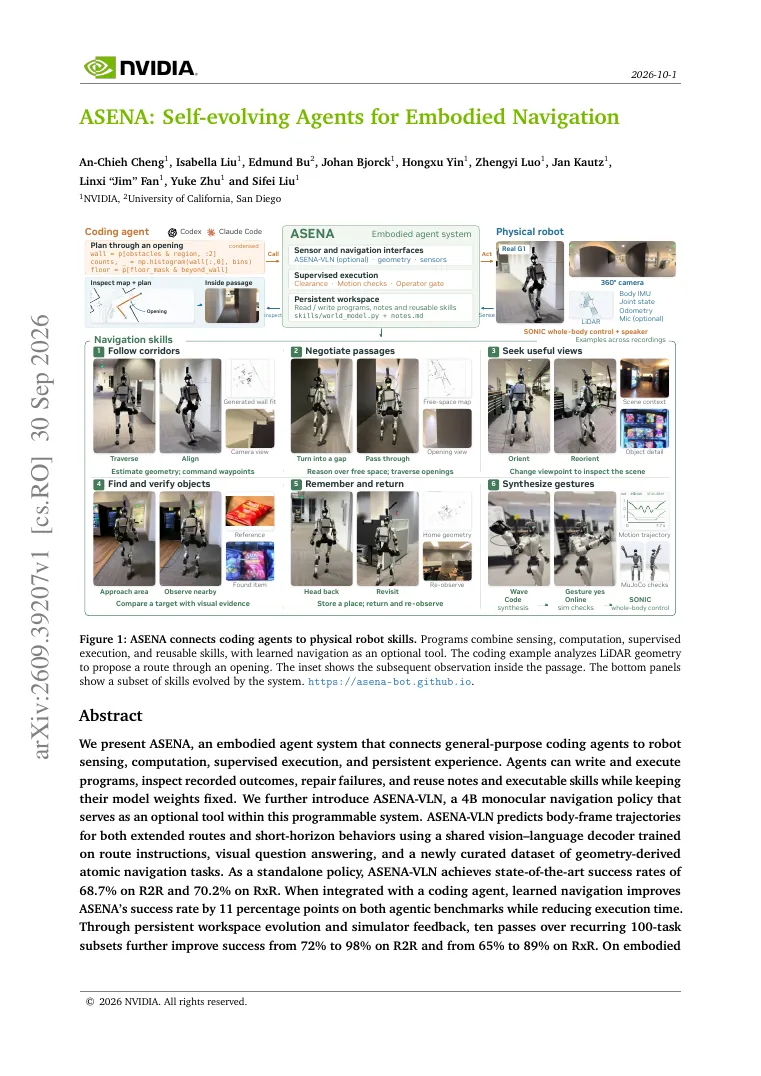
ASENA couples coding agents to robot sensing, supervised execution and persistent workspace on Unitree G1; includes optional 4B monocular VLN policy ASENA-VLN.
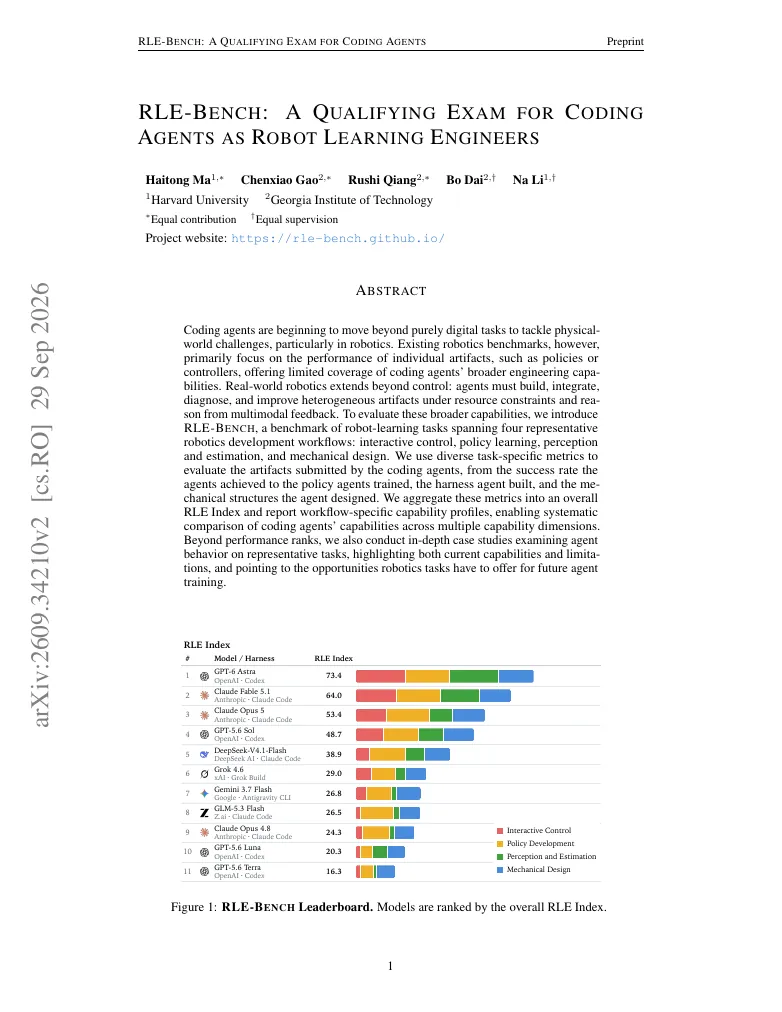
Benchmark evaluating coding agents on robotics development workflows including whole-body humanoid motion tracking on Unitree G1 using LAFAN1 clips in MuJoCo-Warp/MuJoCo-C.
PReFlow combines critic-based proposal selection from a behavior flow with a conditional refinement flow for offline RL policy extraction.
On-policy max-entropy RL that fits an entropy- and KL-regularized target via forward KL using SNIS without critic action derivatives.
Capability-constrained semantic coverage planning for aerial/quadruped teams, evaluated in Isaac Sim; terrain classes constrain both allocation and traversal paths.